Posts

Showing posts with the label Non-Fiction

288. The Case of Wagner, Nietzsche Contra Wagner, and Selected Aphorisms by Friedrich Nietzsche

Image
The Case of Wagner, Nietzsche Contra Wagner, and Selected Aphorisms by Friedrich  Wilhelm Nietzsche is a collection of two essays and a selection of aphorisms on the Nietzsche's views on the music of Wagner in particular and the problem of degeneracy and the dangers of accepting it as the main culture. I read this e-book only because I wanted to read something by Nietzsche not because I truly understand high-culture or Classical Music, to which Wagner's music belongs. Though I enjoy this music genre. Yet, I do agree with Nietzsche on the need to guard against the tendency of misconstruing degeneracy for the norm at any epoch. As has happened today. Reading this essay, I shivered to think of what the author's response would have been to today's compositions, if there are any. Especially since Wagner, whom he critiqued caustically, is considered a virtuoso today by all standards and for whom a whole festival was organised to mark his two hundredth year last year. How...

270. Dreams in a Time of War by Ngugi wa Thiong'o

Image
Stories of the atrocities and ills committed during colonialism most often seem fictional to people's ears, especially those who never lived within the period and never directly experienced them. To those twice removed from the action, it sounds like a fantastic tale told to children around the firelight, beneath the full moon. This might have occurred because for the larger part of the twentieth century, this has been the motif for several African writers - poets, novelists, dramatists. However, nothing is as real as the wanton devastation of the people by the colonists and colonialists in their bid to own the land and subjugate, or in their own way civilise, the people. It is through the biographies and memoirs of those who lived the times that the true effects of what was meted out to our fathers and grandfathers come alive. It is easy for one to disregard fiction, but not too easy to ignore a memoir.  And in the childhood memoir of Ngugi wa Thiong'o, one of Africa...

260. Indaba, My Children - African Tribal History, Legends, Customs and Religious Beliefs by Vusamazulu Credo Mutwa

Image
For most Africans the history of their lives, their culture, their ancestors, begins from the point of entry of the unknown men with pale skin, who would later become the colonialists and the oversea slave traders. To most of us who have gone through formal education studying subjects like Social Studies, Life Skills and a bit of History, not as an Elective but as a core, the farthest we can trace our history is to the borders of the Mali, Songhai and Ghana Empires. Even then, we do not know how they are linked to our present selves. Thus, to ask a Ghanaian student - to be specific on what I can guarantee, though I know this might largely apply to several Africans - to think of his ancestors beyond this period is to ask him to risk haemorrhaging his brain cells or to cause him to hallucinate holographic images of people whose faces he cannot outline or describe and whose deeds he does not know. Yet, it is ironical that these same folks who know nothing about themselves, their or...

239. My First Coup D'etat - Memories from the Lost Decades of Africa by John Dramani Mahama

Image
My First Coup D'etat - Memories from the Last Decades of Africa (Bloomsbury, 2012; 318) by John Dramani Mahama is a memoir spanning the period of his childhood to the time he arrived from Russia after his postgraduate degree. Though this is a memoir of the author, it is also his memories in relation to his family, his country - Ghana, and Africa as a whole. John Dramani Mahama talks about his childhood experiences in all the places he has lived - Damongo, Busunu, Accra, Tamale, Nigeria, and Russia. However, the major subject that runs through this memoir is the numerous coups that plagued the country and the continent during the period and their effects on him and his family; but more especially the effect of the 1966 coup that toppled Nkrumah's government of which his father was a Minister of State.  Mahama's father was among several other government politicians who were arrested and detained after the coup. The most conspicuous effect of the author's father...

236. Antifragile: Things That Gain from Disorder by Nassim Nicholas Taleb

Image
Nassim Nicholas Taleb in Black Swan - the Impact of the Highly Improbable , the second book in the trilogy referred to as Incerto, discusses rare and consequential events, which, because they occur at the tails are almost always ignored and easily explained away after they have occurred. The experts, in the fullest exhibition of their epistemic arrogance, predict that such events are one-time events and would never occur again and so are always fooled by the randomness of their occurrence. These events, in the 4th quadrant, are extremistan events. In Antifragility - Things That Gain from Randomness (Random House, 2012; 519), Nassim explains how we can benefit from these rare and consequential events by decreasing our downside to it or by employing the technique of skin-in-the-game. The book shows how we can avoid becoming the turkey which was surprised on the 1000th day after having been fed consistently for 999 days.  According to Nassim, Black Swan events are needed to mak...

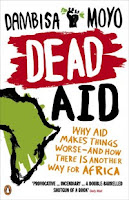
231. Dead Aid - Why Aid Makes Things Worse - and How there is another Way for Africa by Dambisa Moyo

Image
Dead Aid - Why Aid is not Working and How there is another Way for Africa  (Penguin, 2009; 208) by Dambisa Moyo takes a revolutionary look at how Africa's development is financed and whether aid has had any significant impact in Africa to merit its continuous existence. Divided into two parts - A World with Aid (Part I) and A World without Aid (Part II) - Dambisa argues, with researched facts and figures to support her argument, that aid, instead of lifting the majority out of poverty, does nothing of that sorts and that  it could even make countries become poorer and become encumbered and frustrated with debt and its servicing. In Part I, she discusses the Myth of Aid, provides A Brief History of Aid, shows why Aid is not Working, and why it could be The Silent Killer of Growth. Her arguments are compelling and would make the reader think twice. Though I'm not capitalist in thought (I'm what one might refer to as a Social Capitalist - using a country's resources...

230. Fathers & Daughters - An Anthology of Exploration by Ato Quayson (Editor)

Image
Fathers & Daughters - An Anthology of Exploration  (Ayebia Clarke, 2008; 200) is a collection of essays, poems and short stories about the relationships between daughters and fathers told from the point of view of either the father or the daughter. There is that belief, true or otherwise, that a daughter's first love is the father. Yet, it is all too clear that in Africa, this father-daughter relationship has poorly been explored. Ato Quayson's book is the first book I have come across that donates its pages to such an important exploration. It is said that until the lion learns to speak, tales of the hunt will always favour the hunter. Thus, until fathers learn to tell their side of the stories, men's representation in African novels will always go against them. The role of men in books like Nervous Conditions , So Long a Letter , Joys of Motherhood , Purple Violet of Oshaantu , Purple Hibiscus , Opening Spaces: African Women Writing  and many others are nothing...

224. Speeches that Changed the World by Emma Beare (Editor)

Image
Speeches that Changed the World (Bounty Books, 2006; 192) edited by Emma Beare is a collection of speeches, interviews, dialogue and one-liners that are supposed to have marked an epoch in time. Sometimes these epochs are not long-lasting and the speeches not-world changing; sometimes the reverberations of the outcomes of the speeches can still be felt today, like John F. Kennedy's speech that empowered NASA and sparked the space race, which promised that America will put a man on the moon before the end of the 1960s and did. Today, Curiosity is on an exploratory tour on Mars. However, some of these speeches are there only for their beauty; this is the case in most of the one-liners - like the ones by Princess Diana - whose significant impact on world cannot be determined. Same can be said of Mark Anthony's speech delivered at the death of Caesar. The collection is mostly West-centric and not comprehensive enough. The only Africans in there are Nelson Mandela and F. W. d...