Posts

Showing posts with the label Author's Country: Nigeria

303. Black Ass by A. Igoni Barrett

Image
"Furo Wariboko awoke this morning to find that dreams can lose their way and turn up on the wrong side of sleep." With this foreboding line Igoni Barrett ushers the reader into the complex and funny world of Furo Wariboko who woke up one morning to find himself transformed into a Caucasian with a black-patched bottom, green eyes and red hair. However, this furious instantaneous genetic mutation did not affect his speech and so Furo looks like a foreigner but speaks like a Nigerian. How will Furo, a young graduate born and bred in a low-income suburb of Lagos and attending his first interview on the first day of this startling transmogrification, navigate the dangerous curves and turns of this identity quagmire? How will he convince people of his Nigerian identiy, when his looks rejects his name and his documents reject his looks? How will he face his family and tell them that he is the Furo they knew the night before? How will they reconcile the two Furos into his new phys...
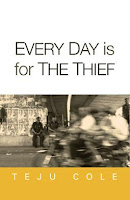
301. Every Day is for the Thief by Teju Cole

Image
Every Day is for the Thief (2007; Cassava Republic) by Teju Cole is an interesting story that is difficult to categorise, if you are one in love with such mundane activities. In some aspects it is a novella - Teju says: " Every Day is for the Thief, written after I revisited Lagos after a long absence, is a novel "; however, in an attempt 'to capture a contemporary moment in the life of the city'...'much of the impetus comes from real-life events '. In this aspect, Every Day is for the Thief   is not just your everyday novel. It is more than that. The writing style, the plot (actually there was none), and the unnamed narrator writing about his travel makes it read like a travelogue, creative non-fiction style. However, at what point is a work of fiction, fiction? Or what proportion of fiction is required for a work to be described as such? Realist writers, whatever that term might mean, writes of the everyday happenings that the reader, if the book is set i...

298. Born on Tuesday by Elnathan John

Image
I have criticized the Caine Prize for pandering to a certain trope of stories. I can recite the number of times that the 'the poor/refugee boy waiting for a miracle from the West and killing people or finding dead bodies in the interim' has won the Caine Prize. In fact so severe was my aversion to this trend that I altogether stopped reading the short stories. It was as if there was a hidden agenda and every story must conform. In fact, I felt justified when in 2012 the chair of judges said they will look  ' beyond the more stereotypical narrative .'  And Elnathan John has been shortlisted twice - 2013 and 2015. The story, Bayan Layi , which developed into Born on a Tuesday was shortlisted in 2013 . By 2013 I had lost all interest in the prize and had stopped reading the stories for my Short Story Mondays . When the Writers Project of Ghana selected this book for its book for June, I did not know what to expect. I had no knowledge that it had developed from a sho...

290. How to Spell Naija in 100 Short Stories Vol. 1 by Chuma Nwokolo

Image
Chuma Nwokolo may not be a household name. But those who have listened to him read or have read his books have come to appreciate his stories. To such fortunate folks Chuma remains an excellent author with a keen sense of observation and of humour. Recently the author of Diaries of a Dead African  and The Ghost of Sani Abacha  released another collection of short stories titled How to Spell Naija in 100 Short Stories  to mark the centenary anniversary of the amalgamation of the pre-Nigerian states and the formation of the country Nigeria. Those who have read Chuma have come to appreciate his unique writing styles and his prodigiousness. First, according to the author his attention span is too short for a novel, so that even the novel-like DOADA is really three interlinked novellas. Consequently, the author has resorted to the short story genre to tell his stories and over time has mastered the rudiments of this genre.  The Ghost of Sani Abacha contained twenty...

289. Americanah by Chimamanda Ngozi Adichie

Image
Every art enthusiast has at least an artiste he or she is dedicated to, whom he would follow thoroughly. They may not necessarily like everything about these artistes but they make it a point to know them and their works. This is common about musicians and visual artists. Almost five years ago, when I was making a list of  100 Books I want to read in five years , I took such a decision. I promised myself I would read every book  Chimamanda  publishes, irrespective of the reviews that she would garner. (Another author I mentally selected was Ayi Kwei Armah.) Since then I have read all four of Adichie's known published books, including  Americanah  (Fourth Estate, 2013) ,  the author's third novel after the highly-successful  Half of a Yellow Sun  (2006) and her fourth published book following her anthology of short stories,  The Thing Around Your Neck   (2009).  When a writer achieves success and fame with his early works and ...

273. A Bit of Difference by Sefi Atta*

Image
As I pointed out in an earlier post, the discourse or specifically the debate in African literature currently is about the poverty-porn (death, more death, disease, hunger, war, famine, and anything with shock-value) and Afropolitanism. This debate came about when it became obvious that the only stories by Africans that gain headlines and about which all the buzz is made are those that deal with the former. Most often the quality of the prose is sacrificed for the macabre theme, sidelining authors who write differently. However, irrespective of which side of the debate you stand, the fact that " Africa now has the fastest-growing middle class in the world [with] some 313 million people, 34 percent of Africa's population, spending USD 2.2 a day, a 100 percent rise in less than 20 years " [ The Network for Doing Business ] means that one story cannot represent all the complexities and contradictions the continent poses, like the abject poor and the super-rich occupying t...

268. Women of Owu by Femi Osofisan

Image
Femi Osofisan's Women of Owu  (UP PLC, 2006; 78) is considered a re-reading of Euripides' The Trojan Women . The story is about the plight of the women in a defeated town. Oyo mercenaries and warriors from the tribes of Ijebu and Ife had surrounded the city of Owu, on the premise that they were there to liberate the people from their oppressive King. After 7 years of siege, the walls finally gave and the allied forces entered. Sparing none, they killed all men and children and some women. For majority of the women, the leader of the forces and his followers made whores and wives out of them.  The story discusses how the gods of the Owu people deserted them and the major reason for the invasion. It was clear that the wife of the leader of the combined forces had been captured and married to the King of Owu, in an earlier military campaign against the the Oyo people; this loss transformed the artist husband into a military commander and hence this attack. The other reason...