Showing posts with label Author: Binyavanga Wainaina. Show all posts

Tuesday, July 19, 2011

One Day I will Write about this Place by Binyavanga Wainaina

I first heard of, and met, Binyavanga Wainaina at the American Corner of the Legon Centre for Foreign Affairs (LECIA) of the University of Ghana. He had come there with another literati, Kojo Laing, whom I was also meeting for the first time. In his white linen trouser and long-sleeved round-neck top and green shoe, I settled to listen to this eccentric author in the company of friends. He informed the audience that what he was going to read would be from the manuscript of an upcoming memoir. Like most authors, he brought out his Apple laptop with care and set it on his lap. Opening it, he set out to read to us paragraphs. All I remember now from the reading is the tiny voice he had used to read to us pictures from his childhood and, most importantly, the loud laughter that followed every line.

The very next day I requested to be his friend on facebook. For those who are still not sure of whom he is, Binyavanga Wainaina is the author of, arguably, the most referred to satirical article on writing 'about Africa' titled How to Write about Africa. He is also the 2002 Caine Prize winner and founding editor and publisher of Kwani?.

I was therefore happy to read about the publication of his memoir One Day I will Write about this Place. According to Granta Magazine:
Binyavanga Wainaina tumbled through his middle-class Kenyan childhood out of kilter with the world around him. This world came to him as a chaos of loud and colourful sounds: the hair dryers at his mother's beauty parlour, black mamba bicycle bells, mechanics in Nairobi, the music of Michael Jackson - all punctuated by the infectious laughter of his brother and sister. He could fall in with their patterns, but it would take him a while to carve out his own. In this vivid and compelling debut, Wainaina takes us through his school days, his failed attempt to study in South Africa, a moving family reunion in Uganda, and his travels around Kenya. The landscape in front of him always claims his main attention, but he also evokes the shifting political scene that unsettles his views on family, tribe, and nationhood. Throughout, reading is his refuge and his solace. And when, in 2002, a writing prize comes through, the door is opened for him to pursue the career that perhaps had been beckoning all along. Resolutely avoiding stereotype and cliche, Wainaina paints every scene in One Day I Will Write About This Place with a highly distinctive and hugely memorable brush.
Similarly, Ngugi wa Thiong'o
Binyavanga Wainaina is a singer and painter in words. He makes you smell, hear, touch, see, above all, feel the drama and vibrations of life below the brilliantly and concretely captured surface of things in Kenya and Africa. The memoir bursts with life and laughter and pathos in every line and paragraph.
The book is available on Amazon.com. Also, be sure that when it becomes available in Ghana, ImageNations would bring you his views on and review of this book. Until then, I would want to say that if you want a different narrative about Africa, read this book.

Thursday, May 20, 2010

An Evening with the Greats

Yesterday evening was an evening to remember. It is the dream of every budding writer to meet other writers who have published their works and whose name is common to all. Yet, greater joy comes from not knowing who the person only to be told that he is an award-winning writer. 

Yesterday evening, at the American Corner of the Legon Centre for International Affairs (LECIA), I had the privilege of meeting two great writers of our time: Kojo Laing, whose latest novel, Big Bishop Roko and the Altar Gangsters, I reviewed on this blog and the Kenyan author Binyavanga Wainaina.

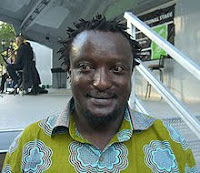
Binyavanga Wainaina
Binyavanga Wainaina is a Kenyan author, journalist and a 2002 Caine-Prize winning author of Discovering Home. He is also the founding editor of Kwani?, a literary magazine in Kenya. He is also the Director of the Chinua Achebe Centre in New York.

Binyavanga read from his yet to be published memoir. His reading captivated us all and left us laughing with its humour and character descriptions. Before Binyavanga entered the room we were discussing the issue of identity in writing. Should the author projects his identity in writing or should he allow his creative imagination to wonder wild even if it would lead to some Enid-Blyton-like stuff being produced. Binyavanga summed it all up by saying that it is difficult to appreciate what you have and mostly others see more in your surroundings than you would see yourself. Also, it is good to allow your creative imagination to rule you. Kojo Laing commented by quoting Wole Soyinka: "The tiger does not advertise his tigritude".

Presently, whilst writing this blog, I just realised that I have shared with my friends on facebook Binyavanga's essay 'How to Write About Africa'. This piece is one of the most interesting piece I have ever read and it portrays the stereotypic mentality of people concerning Africa.

Kojo Laing
At the end of the reading questions were asked by the audience and it was through this Q&A that I got to know the reasoning behind Kojo Laing's Big Bishop Roko and the Altar Gangsters. I know if I had met him earlier and heard his responses my reactions to the review would definitely have ben different.

All in all it was a great evening. However, a copy of Kojo Laing's book could be obtained at Amazon.
Related Posts Plugin for WordPress, Blogger...

Featured post

Njoroge, Kihika, & Kamiti: Epochs of African Literature, A Reader's Perspective

Source Though Achebe's Things Fall Apart   (1958) is often cited and used as the beginning of the modern African novel written in E...