Posts

Showing posts with the label Author's Country: Ghana

Smiles from 35,000 ft

The lines blurred over teary eyes As yesterday's sentences crawled through the crenels of a hypnic-jerk mind Afraid to think of things the world taboos Yet bold to defend it resolutely in conversation with itself As I looked down from the roof of the earth I recreated your little cheeks swelling with laughter... the twilight twinkles in those tiny eyes... We may have endlessly, hopelessly fallen into this thing which has for years written itself into society's hypocritical epithet And we may have to ball it up and dump it in their dump-truck... Or timidly follow their path and forever hide this primal base from their accusatory eyes, away from: Them who hide their dangling scrotums in hideous togases to deceive naive maidens Them who walk the shore to rebuke the footprints of yesterday's memories Them who cast stones from behind books and creeds... But tell me, how does one bury a sailing cork? Why should one pluck a smile from 35,000ft and smash it agroun...
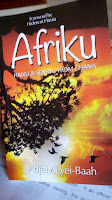
304. Afriku - Haiku & Senryu from Ghana by Adjei Agyei-Baah

Image
Art is dynamic. Art is adaptive. And regardless of where it originates, and with what rules, it is bound to transform and adapt to different cultures. The debate has always been to stick within the rules, be novel with the rules, or to break the rules entirely. But it is these debates, and how they are treated by active-passive artists and the critics alike, that makes art simply ART. It is what has kept it valuable and relevant in an age where the computer is determined to take over our lives and transform everything into a virtual non-reality. Haiku is just one poetry form. It is perhaps the shortest poetry form, albeit with the longest set of rules. One Haijin (a Haiku poet), Jane Reichhold wrote in her book that one must learn all the rules, practice them, and break them. This is such a difficult thing to do, breaking them. Nevertheless, it is what one must do to remain relevant or to adapt the art form to a given culture. And Haiku is one poetry form that requires a lot of ad...

279. No Sweetness Here and Other Stories by Ama Ata Aidoo

Image
No Sweetness Here  (1970; 2013 reprinting by IBSS; 157) by Ama Ata Aidoo is a collection of eleven short stories. Though the title is familiar I have always thought of it as a novel. The short story genre had been used by some writers mostly to fill the interregnum between novels. However, I am pretty sure this was not its purpose in Aidoo's case. The stories in here are quintessential Aidoo, though I have read just a few of her works; they are realistic and examine our daily lives in such a way as to prove, irrefutably, that nothing much has changed; that modernity only adds gadgets and equipment without changing the basic behaviour of humans. If anything at all, we move in circles and in cycles, repeating events and attitudes. For instance, if you thought that power and promiscuity, or power and domination - specifically, the unconscious repression and discrimination that makes the power-bearer superior to all others, are today's problems then you definitely have to think ag...

266. True Murder by Yaba Badoe

Image
Divorce and separation have become part of the natural phases of family life in the Twenty-first Century. It is almost as if any couple on the verge of marriage know that the next phase of this knot-tying ceremony will be the extrication of the one from the other, and are prepared for it. It is as commonplace as marriage itself. However, whereas divorce, usually but not always, satisfies the wishes of the two consenting adults, its effects on the children are hardly examined. The children who had nothing to do with the choices their parents made become their ultimate victims. Their views are hardly sought or considered in the making of the divorce-separation decision. Rather, all they are told, to assuage its psychological impact, is that limp and trite phrase 'sometimes things just don't work between people'. And with this egocentric statement, delivered with trembling voice by each of the parents at different times, they presume their work done, believing that with thi...

265. Permit for Survival by Bill Marshall

Image
Permit for Survival (Educational Press and Manufacturers Ltd, 1981; 120) by Bill Marshall is a humorous book that captures the socioeconomic life of Ghanaians in the late 1970s and early 1980s. It acts as an aperture through which the reader could observe the sights and sounds of a city bourgeoning with hope, opportunities, aspirations, struggles, squashed dreams, and unsurmountable challenges. The book has recently been released under the title Brother Man. The story opens with twenty-six year old clerk Joseph Jonathan Kofi Kuma, or Jojo as he was affectionately called, faced with the arduous task of preventing his own burial at Anoati, his hometown, after he saw his obituary and funeral announcement in the newspaper. The story tells of the misfortunes that befell him on his journey and after. After the success of this unimaginable quest - similar to some of those embarked upon by Tutuola's Palm Wine Tapster, though not in its mysteriousness - Jojo had to prove to his bureauc...

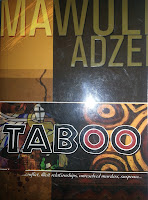
256. Taboo by Mawuli Adzei

Image
The arts and its creators have since creation suffered from man's unrestrained penchant for categorisation. It is this attitude and reflexive thoughts that create good and bad with nothing in between; superior and inferior with destructive consequences. However, to writers and artistes, this Inherent Discrimination Syndrome (do not google this) could stifle creation, especially when the pot is binary or discrete with concomitant bipolar descriptions - negative for A and positive for B. Most work of fiction is classified as either literary fiction or pulp fiction with the academics favouring the latter. Yet, there are several works that could not be easily classified as belonging to either camp. Today, that definite mark is gradually fading, thanks to authors like China Melville.  Mawuli Adzei's Taboo  (Kwadwoan Publishers, 2012; 247) belong to this loose group. The story itself could be described as postmodernist in its deconstruction of culture and its embedded rel...

254. A Review Interview of 'A Heart's Quest by Elikplim Akorli'

Image
This interview is meant to replace the usual review I do for books I have read. There are several reasons for this but the chief one is that I failed to make notes when I read. This will not be a routine. How do you introduce yourself to people, especially the literary side of you? Hmmm, basically I'm simple and down to earth. With literary side of me, I would say I was not trained to write. Writing came to me when nothing else would. I found writing young. It wasn't my first love though; sketching was though I have not developed it as much as I would have loved to. When I write, I write to set myself free irrespective of whatever someone may think or feel. That was the way writing started for me. The more I wrote and experienced life, the more I discovered there were other things to talk about apart from using writing as a personal tool. I write articles and essays sometimes apart from poetry which I consider my usual domain. I have tried short stories but not yet compl...

251. Ama - a Story of the Atlantic Slave Trade by Manu Herbstein

Image
Ama - a Story of the Atlantic Slave Trade  (374; Techmate) by Manu Herbstein won the Commonwealth Writers Prize for the Best First Book in 2002. It explores, boldly, one of the darkest moments of human history when human beings (blacks from Africa) were traded like articles or farm animals. Assessed for defects - muscles, clear eyes, etc. - and for profitability. Thus, in that period, black men and women were no different from livestock - in treatment and in conception.  Manu Herbstein painfully peels off the gangrenes from our necrotic wounds to show us our painful complicity as Africans in our own enslavement and therefore our debasement. To this extent Manu is in league with Ayi Kwei Armah, who in his books -  Two Thousand Seasons and The Healers  - showed how far we went as Africans, how lowly we bowed, how stupidly we grovelled, and how greedily we participated in our own destruction. Armah called the chiefs who stupidly surrendered our sovereignty for p...