Posts

Showing posts with the label Translation

302. The Master and Margarita by Mikhail Bulgakov

Image
The Master and Margarita by Mikhail Bulgakov, written over a twelve-year period (1928-1940) and published posthumously (1967), is a fantastic representation of phantasmagorical events that began with the portentous prediction whose realisation spelt doom for the entire inhabitants of Moscow, creating knots and entanglements that mere rationalisation was unable to coherently unwound or meaningfully disentangle.  The Great Deceiver, who in this case appeared as a great Magician, entered Moscow and, chancing upon a meeting of two literary enthusiasts at Patriarch's Ponds discussing the unending debate of the presence or otherwise of God, began a performance. The two self-professed atheists were strong in their conviction of a non-existent God and proffered argument after argument and hypothesis after hypothesis to support their thesis, until the arrival of Prof. Woland (the devil) and his retinue (Azazello, Behemoth the manlike-cat, Koroviev, Abadonna, and Hella,...
272. Waiting for the Wild Beasts to Vote by Ahmadou Kourouma

Image
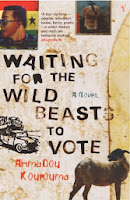
Waiting for the Wild Beast to Vote (Vintage, 2003; 445) is a quintessential Ahmadou Kourouma. Like the previous book, Allah is not Obliged , it is about political failures on the African continent.  Like Wizard of the Crow , it mixes voodoo and African mysticism with politics to satirically tell the story of the evolution of dictatorship and its subsequent metamorphoses into questionable democracies, on the continent of Africa. The story traces how Koyaga developed from a pro-French soldier to become the president and dictator of Republique du Golfe, through a series of prophecies, coups and counter-coups. Fricassa Santos became the president of Republic du Golfe, after independence following an election whose supervision by the United Nations and with Fricassa's own sorcery prevented the French from rigging it to suit their preferred candidate, J.-L Crunet, who had been the country's Prime Minister for the last ten years of colonial rule. Having assumed power, Fricassa...

271. Allah is not Obliged by Ahmadou Kourouma

Image
African literature now has two unnecessary camps - Afropolitanism and Poverty Porn - and the discourse has been on which of the two represents the continent, sort of. But does it matter? Can one narrative represents the second largest and the second most populous continent of a whopping 1.033 billion grouped into "54 recognized sovereign states and countries, 9 territories and 2 de facto independent states with very little recognition"? [ World Population Review , 2013]. That one theme cannot represent the continent is perhaps known by both 'camps'. So what incited this discourse? (By the way, there are several others who do not believe in either of the two and whose writings are not influenced by them.) African writers who wrote in a particular style about wars, poverty, deaths, hunger, and such depravities have often been singled out for awards, even when the quality of their prose does not support the award adequately. It became (and is) the magic formula to f...

264. An Enemy of the People by Henrik Ibsen

Image
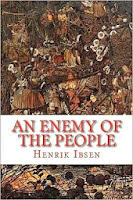
An Enemy of the People  (1882; translated by Farquharson Sharp) by Henrik Ibsen is a play that critically examines society's role in its political and ideological enslavement and the elements that prevent or impede its progress. The questions: whether 'the government of the people by the people for the people' is a concept that exists or is even possible; the 'rightness' of the majority, which is the basis of democracy; and the end result of unquestioned liberalism, are all answered in this stupendous play. It critiques society's choices, and the factors that influence those choices: are the choices leaders make made in the interest of the people or are they made in the interest of a few who, armed with the tools given them by the people, make the people believe the reverse? Or is society deceived to choose the very option that is counter to its interest, serving instead the interest of the privilege minority, as in this story? In this story, set in a Nor...

263. The Confusions of Young Torless by Robert Musil

Image
If one seeks to satisfy his desire diligently and ambitiously, and if he goes a step farther anytime it is attained, one could lose himself. This seems to be the message of Robert Musil's The Confusions of Young Torless  (Penguin Classics, 2001 (FP: 1906) translation by Shaun Whiteside; 160). Musil's story is about sexual repression, oppression and its covert expression. It is the sexual expression of power and the depression that results when it is repressed. Though published in the early twentieth century, Musil discusses several of today's sexual roles and identities: gender trap, homosexuality, and sadism. The latter is talked about with regards to the power it affords the oppressor. Torless is in a boarding house for boys. He is developing sexually and is bothered by thoughts of sex and his sexuality. As these ideas and thoughts inundate him, he is forced to seek refuge from every possible source but her parents, whose faces he could no longer conjure no matter ...

253. Anna Karenina by Leo Tolstoy*

Image
"All happy families resemble one another, but each unhappy family is unhappy in its own way" are the famous opening words of the tragic love story Anna Karenina (FP: 1877; 813) by Leo Tolstoy. This is perhaps the most famous first line one would read. Anna Karenina is a novel of many dimensions with ebbs and troughs. Set in Russia around the time of the liberation of the serfs, the novel deals with society: the people, the laws and the government. The main story revolves around Anna Karenina, the eponymous character of the novel.  Anna Karenina had returned from Moscow, where she had been to solve a problem between her brother, Oblonsky, and her wife, Dolly [Darya], after the former had cheated on the latter with his children's English governess and the marriage seemed destined for disaster. Initially, one would have thought that the story revolves around the Oblonsky family. However, it quickly settles on the Karenins. In Moscow Anna had met the playboy Vronsky, w...

252. God Dies by the Nile by Nawal El Saadawi

Image
God Dies by the Nile*  (Zed Books, FP: 1976; 175) by Nawal El Saadawi is a compendium of political, cultural, social, and religious oppression of a people by a demagogue through a supposed ruling class whom he gets to do what he wants. In this book, Nawal El Saadawi, whose subject of interest revolves around [religious] oppression in a patriarchal society, discusses how a people blinded by religion could become delusional in their depravity and even deemed it the will of God. In this story, set in the village of Kafr El Teen, the Mayor is God, his word is law, and his passions reign supreme. And when this lascivious Mayor set his eyes on the children of an old woman, Zakeya, there was nothing anyone could do but to submit, even if it had to take the Sheikh to turn the words of Allah around to deceive the masses and an unfortunate and helpless woman. Everyone was blinded to the Mayor's deeds and all worked to not only protect him but also praise him to the hilt so that in gro...