Posts

Showing posts with the label Country: India

283. The Satanic Verses by Salman Rushdie

Image
The Satanic Verses  (Viking, 1988; 547) by Salman Rushdie has been one of the most controversial books ever written. On February 14, 1989 a fatwa was declared on its author by the late Ayatollah Ruholla Khoneini. All across the world there were news of book burning and banning, and demonstrations against the author and his works, including some liberals who thought Rushdie overstretched the limits of free speech in his book. Even as the book celebrates its 26 years of publication and the author 25 years of the invocation of the fatwa, emotions have not yet completely fizzled out . In fact, the author had to live incognito and had to move about with bodyguards paid for by some governments. He lived under the assumed name of Joseph Anton - from Joseph Conrad and Anton Chekhov - which became the title of his memoir. The Story:  At over 500 pages, this is no small book and if one read the hardcover with the thick leaves one would feel the physical torment of this book. How...

237. Midnight's Children by Salman Rushdie

Image
Midnight's Children (Vintage, 1981*; 463) by Salman Rushdie is a magical realism cum historical novel about India and its partitioning. It is also the story of Saleem Sinai, born at midnight of India's independence. However, Sinai was not the only one who was born on the stroke of midnight - the eve of India's independence. Altogether, there were one thousand and one children born at or seconds after midnight and these children have been endowed with the special powers. There is a direct relationship between the time of a child's birth and the strength of the powers he or she receives. The closer the time is to midnight the stronger the powers. Saleem and his arch-nemesis Shiva were born on the stroke of midnight and consequently consider themselves as defacto leaders of the children. However, their vision for the children are in direct conflict with each other; whilst telepathic, runny nose Saleem wants to work with all the children for the common good of India, Shi...

209. Fury by Salman Rushdie

Image
I read Fury (Random House, 2001; 259) as an introduction to Salman Rushdie. It was to prepare me for the author's two major works I have on my shelf: Satanic Verses and Midnight's Children . However, I don't know if the book did what I wanted it to do. Having heard a lot about Midnight's Children  - winning the 1981 Booker and the Best of the Booker twice (for the 25th and 40th anniversaries of the award), the idea is to enter it fully prepared with the author's prose-style so that I will enjoy it completely because I also know people have read it and not liked it. Fury was therefore meant to be the introductory text to Rushdie, for me. The story is about a fifty-five year Professor Malik Solanka, a Cambridge philosopher, who leaves his wife and a learning-to-talk son in London for a completely new life in New York. An anomie of sorts; though not religious.  The story follows all the things that happened to him, finding love and losing it and finding love ag...

204. The Inheritance of Loss by Kiran Desai

Image
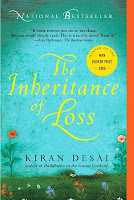
Kiran Desai's The Inheritance of Loss  (Grove Press, 2006; 356), winner of the 2006 Man Booker Prize, is a story about impotence and poverty and how they influence each other. Everybody in this story, rich or poor, religious or non-religious, Hindu or Muslim, Indian or Nepali, is a victim in one form or the other. They, the characters, have relinquished control and decisions to act to an invisible authority; they have made this authority more potent by their willingness to succumb and their unwillingness to take any action to change anything in their lives. Perhaps to them, to think of change is to risk worsening an already worst situation. They have thus accepted their victim-hood. This lethargic acceptance, borne not out of ignorance or pleasure of poverty and which is not on a particular romanticism of a past bucolic life, is something one can describe of Developing Countries. Thus, Kiran's characters are like developing countries - things happen to them; decisions are ma...

134. The God of Small Things by Arundhati Roy

Image
The God of Small Things (Harper Perennial, 1997; 321) by Arundhati Roy won the Man Booker prize in 1997 amid some controversies. Some have gone ahead to describe the book harshly, whilst others have praise the insight of Roy. One thing is however clear The God of Small Things is a book that opens up a society exposing all its rotten innards and demands that we choose but choose wisely. In this novel, Roy examines the lives we live and the choices we make on the lives of the people around us, mostly on the innocent children. She also examines hypocrisy, more especially political hypocrisy, and betrayal by the state, friends, loved ones, and family. Estha and Rahel are more than just fraternal twins. Their soul reach out for each other. One day, whilst on their way to pick their uncle's - Chacko's - daughter, Estha was sexually molested by a hairy man who offered him a cold soft drink. Estha lost his innocence and something lively in him died. And something in Rahel also d...