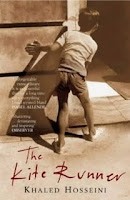
Khaled Hosseini's debut novel,
The Kite Runner (2003; 391), could easily pass as the best non-African authored book I've read this year, if not for
1984. The novel tracks the life and friendship of two individuals, Amir - the son of a Kabul merchant - and Hassan, the child of their servant, Ali as they grow in the affluent suburb of Wazir Akbar Khan District of Kabul. As their friendship unfolds, the history of a land that has been plagued by local and international wars unfolds. In fact, it is this very wars, leading to the overthrow of monarchs and governments, that dictated how the friendship between these two individuals went. Yet, the precursor of all the events is the age old tradition or practice of discrimination based on physical features.
Amir has slim face and nose and is a Pashtun so is considered to be aristocratic, worthy of ruling the land and Hassan his friend has a moon-shaped face, slit-eyes and a Hazara so is cast to be a servant forever. With only a year separating their births, Hassan - the younger - and Amir continued the friendship between Amir's father, Baba, and Hassan's father, Ali. Yet Ali and his son Hassan knew their place in Baba's household, always keeping to their hut and coming to the main house to only to serve. Though Amir plays with Hassan he actually does not consider him to be his friend; yet the latter is absolutely loyal to the former.
Everything changed the day Hassan won the Kite championship. Hassan - an experienced kite runner - decided to bring Amir the last kite he cut that gave him the title to be kept as his trophy. When Amir followed Hassan and saw what Assef and his two friends were doing to Hassan, he stood aloof. Afraid. Did nothing. Saw the chance to claim his father's sole attention. And took it.
May be Hassan was the price I had to pay, the lamb I had to slay to win Baba. Was it a fair price? The answer floated to my conscious mind before I could thwart it: He was just a Hazara, wasn't he?
Amir's inability to redeem himself led to more problems and complications. Later, accused of theft, Ali and Hassan left the Amir's household.
After a series of political upheavals and revolutions Baba and Amir moved to America. Living a fulfilled life in America, Amir received a call from his father's partner Rahim Khan offering Amir the chance 'to be good again'. This call took him back to Afghanistan through Pakistan to correct a past wrong; to uncover family secrets; to identify who he really is and if all his life has been lived in lies.
Behind all these is the story of a country that was changing from a peaceful, stable, economically active country into a country whose name would forever remain synonymous with war, shari'a, death, foreign invasion and more. Khaled Hosseini traced the history of Afghanistan from the 1960s when the country was ruled by a monarch to the period of American invasion and the overthrow of the Taliban. Beginning with a fully-running country where religion is not a problem, the story ended with a country in ruins and desolation; a country where common food is the preserve of the elite rulers and their bootlickers; a country where people are stoned to death for not wearing the hijab. All because individuals and countries always think that they know what is best for this country. From the overthrow of the King, the entry of the Mujahideen, the Russians, the Alliance troops, the Taliban and finally the Americans, Khaled Hosseini shows how each of these groups and countries contributed to the ruins within which Afghanistan finds itself today.
Written in the first person, without unnecessary flamboyancy, Khaled has written a book that would remain with the reader for a long period of time. This is a story that teaches a lot and opens eyes. I highly recommend it to anyone who wants to see more than the current Afghanistan we know and want to know how the Afghanistan we now know came to be. I look forward to reading his A Thousand Splendid Suns.