Posts

Showing posts with the label Country: Russia

302. The Master and Margarita by Mikhail Bulgakov

Image
The Master and Margarita by Mikhail Bulgakov, written over a twelve-year period (1928-1940) and published posthumously (1967), is a fantastic representation of phantasmagorical events that began with the portentous prediction whose realisation spelt doom for the entire inhabitants of Moscow, creating knots and entanglements that mere rationalisation was unable to coherently unwound or meaningfully disentangle.  The Great Deceiver, who in this case appeared as a great Magician, entered Moscow and, chancing upon a meeting of two literary enthusiasts at Patriarch's Ponds discussing the unending debate of the presence or otherwise of God, began a performance. The two self-professed atheists were strong in their conviction of a non-existent God and proffered argument after argument and hypothesis after hypothesis to support their thesis, until the arrival of Prof. Woland (the devil) and his retinue (Azazello, Behemoth the manlike-cat, Koroviev, Abadonna, and Hella,...

253. Anna Karenina by Leo Tolstoy*

Image
"All happy families resemble one another, but each unhappy family is unhappy in its own way" are the famous opening words of the tragic love story Anna Karenina (FP: 1877; 813) by Leo Tolstoy. This is perhaps the most famous first line one would read. Anna Karenina is a novel of many dimensions with ebbs and troughs. Set in Russia around the time of the liberation of the serfs, the novel deals with society: the people, the laws and the government. The main story revolves around Anna Karenina, the eponymous character of the novel.  Anna Karenina had returned from Moscow, where she had been to solve a problem between her brother, Oblonsky, and her wife, Dolly [Darya], after the former had cheated on the latter with his children's English governess and the marriage seemed destined for disaster. Initially, one would have thought that the story revolves around the Oblonsky family. However, it quickly settles on the Karenins. In Moscow Anna had met the playboy Vronsky, w...

249. The Karamazov Brothers by Fyodor Dostoevsky

Image
The Karamazov Brothers (870; 1880)* is the second book by Fyodor Dostoevsky I have read, in addition to Crime and Punishment .  The book counts towards two reading challenges: the Year of Russian Literature and Top 100 Books to be Read in Five Years . In this book, which happened to be the author's last work, Dostoevsky traversed several grounds and themes and perhaps knowing (or through serendipity) completely and fully invested himself and his knowledge in this book. I am not sure of this, but The Karamazov Brothers  could be a cauldron of a major part of Dostoevsky's ideas. In effect, this author-researcher, this psychologist of a novelist, this student of human nature and thoughts, produced a seminal work, worth studying in different fields of social sciences, in this novel. Thus, to describe The Karamazov Brothers  as a novel is an understatement. It does the book a huge injustice and undermines its quality. This is a compendium of human thoughts, psych...

243. Crime and Punishment by Fyodor Dostoevsky*

Image
Crime and Punishment  (485; 1866)* by Fyodor Dostoevsky is the first book I have read by the author and the third by a Russian. It contributes towards fulfilling the Year of Russian Literature objective. A lot has been said about how great this book is; it is on almost every 'Best Books' list including my reading challenge list - the Hundred Books to be Read in Five Years . It has been reviewed so much that there possibly is nothing more to add. However, like Leo Tolstoy's War and Peace ,   and all my reviews here on this blog, I will attempt to put down how I understood the book; not how it has generally been received. Crime and Punishment  introduced me to the oft-quoted statement or insinuation that the Russians are ' the world's hardest writers '. Perhaps one could also include the Germans. In C&P, Dostoevsky takes the reader on a mental or psychological tour of the thought-processes, the minutest details, of decision-making; of creating or estab...

238. The Government Inspector by Nikolai Gogol

Image
Unlike novels, or even novellas, plays focus on a micro-theme or subject matter and treat it in a way as to make the observer (or reader) think and to effect a change, possibly. Again, unlike novels and novellas which are always originally meant to be read (but which have recently been adapted to the screens), plays are written for the stage and therefore their message is taken in as and when they unfold and the curtains furl and must therefore be short and precise and employing different theatrical devices grab the attention of listeners and deliver their messages. Thus, a play must dramatise events. And Nikolai Gogol's The Government Inspector  (1836; translated and adapted by D. J. Campbell) meets these features excellently. The Government Inspector is a satirical and comic representation of corruption in the public service of Tsarist Russia with cartoonish characters. Officials in a town, headed by a Mayor, receive information of the visit of a Government Inspector travel...

233. War and Peace by Leo Tolstoy

Image
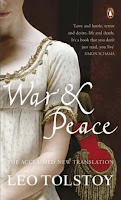
War and Peace by Leo Tolstoy (FP: 1869) translated by Anthongy Briggs (Penguin, 2005; 1392) is divided into four volumes and an epilogue and other extras. The reviews were carried out in the volumes and this is to consolidate for easy reference. Volume I:  This 313-page volume introduces the reader to the Bolkonskys - Prince Nikolay Bolkonsky, the father; Prince Andrey, the son married to little princess Liza, and Princess Marya, the daughter; the Rostovs - Natasha, the daughter; Nikolay, the son; Petya, the younger son, Vera, the eldest daughter; the Kuragins - the scheming Prince Vasily Kuragin who, unable to outwit Pierre (later Count Bezukhov of his inheritance), married his daughter, Helene, to him and was about to marry his son, the troublesome Anatole to Princess Marya because of Prince Nikolay Bolkonsky's riches but he failed. There was also the scheming Anna Mikhaylovna and his son Boris. ( continue here ) Volume II:  In this part, Prince Andrey Bo...

Volume IV: War and Peace by Leo Tolstoy

Image
Volume IV  (1035 - 1256) of  War and Peace  by Leo Tolstoy (FP: 1896) and translated by Anthony Briggs (Penguin, 2005; 1392) begins with a life in Petersburg after the abandonment of Moscow. It also shows how the Russians struggled to uplift themselves from the clutches of French culture and its recherche lifestyle. It should be noted that this is a period where the speaking of French is seen as the ultimate achievement of Russian gentry. However, this invasion blossomed in their hearts a sense of belonging and a sense of patriotism that traverse all aspects of life, including language. Life in Petersburg initially seemed to be unaffected and untouched by the invasion of Moscow; the aristocrats still held their parties, loose talks still flew around, and all thoughts of war and death were suppressed. However, as the news of Moscow's abandonment gradually filtered to the people, a general despondency overcame the people. In Moscow, Pierre who had been arr...

Volume III: War and Peace by Leo Tolstoy

Image
Volume III (665 - 1034) of War and Peace by Leo Tolstoy (Penguin, 2005 (1392); FP: 1869) translated by Anthony Briggs begins with a critical analyses of the human condition and human nature and man's place and role in world events and history and the misconception and false attributions that is fraught in our analyses of causes. Tolstoy's essay discusses predestination, man's role in humanity's history and the belief that man has control over historical events. Tolstoy agrees with (or Nassim Taleb rather agrees with Tolstoy) on man's epistemic arrogance regarding man's quest to understand events. He argued that man, with the benefit of hindsight, pretends to understand historical events when in fact he understands nothing and only isolates some actions as having caused such events because he can now, post-facto, look back and select any of the numerous causes and claim boldly that what he has identified is (or are) the real (true, actual) cause(s) of the even...