Posts

Showing posts with the label Man Booker Book

241. Oscar and Lucinda by Peter Carey

Image
Oscar and Lucinda  (Faber and Faber, 1988; 512) by Peter Carey won the Booker Prize in 1988. It was also short-listed for the Best of the Booker in 1993 to celebrate the award's 25th anniversary alongside such books as Midnight's Children by Salman Rushdie (the winner), The Conservationist  by Nadine Gordimer, Disgrace  by J. M. Coetzee, The Ghost Road by Pat Barker, and The Siege of Krishnapur  by J. G. Farrell.  Oscar and Lucinda  is a quasi-romance, quasi-historical, novel narrated by the great grandson of Oscar Hopkins but in an omnipresent manner. The story, though a narration, explored the pathways, decisions, eccentricities, trials and tribulations, and weirdness of Oscar Hopkins and Lucinda Leplastrier. The story traces the lives of these two eccentrics before they met on the Leviathan  on their way to Sydney and after they arrived. It details their inchoate love affair, their problems, and their doom. Oscar Hopkins brought up ...

237. Midnight's Children by Salman Rushdie

Image
Midnight's Children (Vintage, 1981*; 463) by Salman Rushdie is a magical realism cum historical novel about India and its partitioning. It is also the story of Saleem Sinai, born at midnight of India's independence. However, Sinai was not the only one who was born on the stroke of midnight - the eve of India's independence. Altogether, there were one thousand and one children born at or seconds after midnight and these children have been endowed with the special powers. There is a direct relationship between the time of a child's birth and the strength of the powers he or she receives. The closer the time is to midnight the stronger the powers. Saleem and his arch-nemesis Shiva were born on the stroke of midnight and consequently consider themselves as defacto leaders of the children. However, their vision for the children are in direct conflict with each other; whilst telepathic, runny nose Saleem wants to work with all the children for the common good of India, Shi...

221. Life of Pi by Yann Martel

Image
The Life of Pi (Harcourt, 2001; 326) by Yann Martel won the Man Booker Prize in 2001. It is about the story of faith, struggle and belief in oneself and in the supernatural. It's also about man's relationship with animals and provides some excellent justification for the creation of zoos. It's also an allegory, perhaps, of the journey towards manhood; with the shipwreck and the struggle to survive at sea representative of the adolescent stage. Eleven-year old Piscine Molitor Patel is travelling with his parents as they relocate to Canada. They ship they were travelling in sank and through a series of incidences, some of them not directly observed by Piscince (or Pi), he found himself with a hyena, a zebra with a broken leg, an orang-utan, and a Bengal tiger on his lifeboat. What ensued was a series of carnivorous expressions and after a few days floating at sea, it was left with Pi and his Bengal tiger. The mission was on how to 'tame' the 450-pound monstrosi...

213. The English Patient by Michael Ondaatje

Image
The English Patient (Vintage International, 1992; 302) by Michael Ondaatje is a story about four people set in the period of the second World War in North Africa and Italy: an enigmatic figure referred to simply as The English Patient, because he claims to be English but who was later revealed to be Count Ladislaus de Almásy, an Indian - Kirpal Singh (or Kip, the sapper) an expert in locating and defusing bombs, a young nurse, Hana, whose father died in the war and a Canadian thief, Hana's father's friend, Caravaggio. Almásy or the English Patient arrived at hospital burnt and without identification except a copy of annotated book of histories by Herodotus. Revealing nothing to anyone, Hana became interested in his situation, perhaps seeking redemption for his father's death. When the hospital was moved away from the monastery-turned-hospital to a more appropriate place in another town where there would be facilities and equipment to cater for the sick, Hana chose to ...

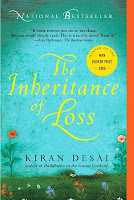
204. The Inheritance of Loss by Kiran Desai

Image
Kiran Desai's The Inheritance of Loss  (Grove Press, 2006; 356), winner of the 2006 Man Booker Prize, is a story about impotence and poverty and how they influence each other. Everybody in this story, rich or poor, religious or non-religious, Hindu or Muslim, Indian or Nepali, is a victim in one form or the other. They, the characters, have relinquished control and decisions to act to an invisible authority; they have made this authority more potent by their willingness to succumb and their unwillingness to take any action to change anything in their lives. Perhaps to them, to think of change is to risk worsening an already worst situation. They have thus accepted their victim-hood. This lethargic acceptance, borne not out of ignorance or pleasure of poverty and which is not on a particular romanticism of a past bucolic life, is something one can describe of Developing Countries. Thus, Kiran's characters are like developing countries - things happen to them; decisions are ma...

202. Amsterdam by Ian McEwan

Image
Ian McEwan is a minimalist. More of a novella-ist than an novelist. The Telegraph quoted him saying ' if I could write a perfect novella I would die happy '. In that same article he was described as 'lucky to be allowed to publish novellas.' If not for the lack of temerity one could say - in finality, in absoluteness - that he is the best novella-ist, for it isn't often that one comes across an author who pares down his words, weighs and analyses them before applying them, cutting out all unnecessary words just to arrive at the precise meaning of what he is carrying across. Such detailed work of cutting out, cleaning, paring, has often been associated with visual artists and poets. And now McEwan. Ewan's style is intense, absorbing, concentrated and focussed. His writings hardly entertain lateral stories, and even when they do they are an integral part of the main and contributes to the strength of the whole, like in Atonement . With his style and structu...

168. The Famished Road by Ben Okri

Image
Title: The Famished Road* Author: Ben Okri Genre: Fiction/Surrealist Publishers: Vintage Pages: 500 Year of First Publication: 1991 Country: Nigeria Ben Okri's The Famished Road  entrenches the writer's style of mixing what others might refer to as surrealism with realism. Like the stories in his collected short stories Incidents at the Shrine , Okri capitalises on the African's abundant belief in the spiritual world, or supernatural, to tell his stories, presenting the reader with a cascade of fantastic images and challenging descriptions. To the African the spirit world is not far off from or diametrical to the physical world; the African believes in the fluidity between the two and believes that children come from the spirit world, just as people go to the spirit world when they die. In effect, the African believes that the world we live in now, the one we see and feel, which could be referred to as the physical world, is just a transit in that infinit...

134. The God of Small Things by Arundhati Roy

Image
The God of Small Things (Harper Perennial, 1997; 321) by Arundhati Roy won the Man Booker prize in 1997 amid some controversies. Some have gone ahead to describe the book harshly, whilst others have praise the insight of Roy. One thing is however clear The God of Small Things is a book that opens up a society exposing all its rotten innards and demands that we choose but choose wisely. In this novel, Roy examines the lives we live and the choices we make on the lives of the people around us, mostly on the innocent children. She also examines hypocrisy, more especially political hypocrisy, and betrayal by the state, friends, loved ones, and family. Estha and Rahel are more than just fraternal twins. Their soul reach out for each other. One day, whilst on their way to pick their uncle's - Chacko's - daughter, Estha was sexually molested by a hairy man who offered him a cold soft drink. Estha lost his innocence and something lively in him died. And something in Rahel also d...

126. The Conservationist by Nadine Gordimer

Image
Title: The Conservationist Author: Nadine Gordimer Genre: Fiction/Race Publishers: Penguin Books Pages: 267 Year of First Publication: 1974 Country: South Africa Mehring is rich, divorced and somewhat frustrated and, though he has a lot of highly-placed friends, he feels alienated. He also deals in pig-iron, so he doesn't classify himself as part of the oppressors regarding the use of cheap black labour in the mines. But Mehring has a farm as most rich South Africans do. In the context and setting of the story, rich is synonymous to white. Though Mehring has a farm, he does not run it for profit. He sees the farm as a place to escape to from the city and he knows nothing about farming so that blacks like Jacobus and Solomon and others are the ones who run the farm and these individuals were living on the land before it was purchased from the previous owner. One day, the body of a black man was found on the farm. Mehring was called and he in turn called the po...

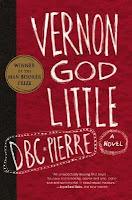
123. Vernon God Little by DBC Pierre

Image
Anyone who read and loved The Catcher in the Rye  will love DBC Pierre's Vernon God Little  (Harcourt; 2003; 277), winner of the 2003 Man Booker Prize. It contains the teenage hormonal angst, the classic misunderstanding, and a heavy dose of teen-lingo and more. The more in DBC Pierre's book - a pseudonym that is almost eponymous to the names of several of the entities in the industry he satirised - is the 'provocatively satirical, riotously funny look at violence, materialism, and the American media' that were the major concern of the this book. In the town of Martirio, sixteen students have been killed. And the town's police officers are working hard to get a culprit by all means necessary, even though the murderer - the Mexican Jesus Navarro - had committed suicide after his slaughter. Enter Vernon Gregory Little, a misunderstood boy of almost-sixteen from a single-parent family and the only friend of Jesus. Vernon's appearance (unshaved hair), Nike bo...

116. On Chesil Beach by Ian McEwan

Image
Ian McEwan's On Chesil Beach  (2007; 166) - read for the Top 100 Books Reading Challenge - seems to continue from where Thomas Hardy left off with the story of Jude and Sue in Jude the Obscure .  In this story, McEwan investigates the changes that was taking place in early 1960s: social, political and economic changes.  Using the story of Florence and Edward, McEwan writes of how the early 1960s served as the turning point in the century. During this period, the British Empire has started shrinking, with several colonists becoming independent. There was also a change in the landscape with a somewhat rapid urbanisation of rural and peri-urban areas. However, the major change that McEwan concentrated upon is the change in relationships or the idea of what marriage is or should be, the major theme in Hardy's story. He toes Hardy's course, though Florence was much stronger than Sue and Edward more foolish than Jude, for Jude made compelling arguments similar, in ...

92. Anthills of the Savannah by Chinua Achebe

Image
Title: Anthills of the Savannah Author: Chinua Achebe Genre: Fiction/Tragedy/Politics Publishers: Heinemann (African Writers Series) Pages: 233 Year of First Publication: 1987 Country: Nigeria Anthills of the Savannah , a 1987 Booker Shortlist, is the fifth book of Achebe's oeuvre I have read. This novel is quite different from the first four of Achebe's books in terms of the narrative style, the prose, the setting and to some extent the theme. Had Achebe not written Things Fall Apart    and my favourite The Arrow of God , this book alone would have established the Man Booker International Prize winner (2007) as one of Africa's literary giants. In this very unique novel, Achebe treats the issue of despots, male chauvinism and power from a rather different and unexpected perspective. He opens up the struggles that goes on behind the power scenes and how easily an innocent, generally good individual could easily transmogrify into an absol...

81. The Handmaid's Tale by Margaret Atwood

Image
The Handmaid's Tale  (402; 1985) is an imaginative dystopian about a fictional world; a place where all rhetorics about women's place in the world are realised. It is also a world that has been lived before. In this novel, Atwood relied on all that had been said and is being said about women and what they should and shouldn't do. In the fictional world of Gilead, the constitutional government of the United States had been overthrown; its place place taken by Gilead, a state based on the Christian teachings and its purpose for women. In Gilead women are grouped into Wives, Marthas, Aunties, and Handmaids. Handmaids are reproductive 'machines' that keep the population of Gilead from declining. And children are the most prized assets of the day. Rich couples unable to bear their own children contract these handmaids to get pregnant for them. A Handmaid who's unable to get pregnant after several 'servicing' with Commanders are described as unwomen. The...