Showing posts with label Author's Country: Mozambique. Show all posts

Thursday, June 09, 2011

82. Every Man is a Race by Mia Couto

Title: Every Man is a Race
Author: Mia Couto
Genre: Short Stories (Anthology)
Translator: David Brookshaw
Publisher: Heinemann (African Writers Series)
Pages:118
Year of Publication: 1991 (Portuguese) 1994 (English)
Country: Mozambique

Asked what his race was, he replied
'My race is me, John the Birdman.'
Invited to explain himself, he added:
'My race is me myself. A person is an individual humanity. Every man is a race, Officer.'
(Extract from the bird seller's statement)  
Every Man is a Race is the second collection of short stories by Mia Couto. It is this collection that established Couto as master storyteller. His stories are known for being magical and surreal. It's always difficult to directly interpret Couto's story. The symbolism is heavy.

Consisting of 18 short stories, Every Man is a Race follows the path of Voices Made Night in style, structure and theme. Couto has a way with words. He makes them come alive. Using little dialogue, Couto tells the story as we have known it told since childhood, when we gathered by the fireside sharing stories among ourselves. His themes ranges from love to politics. 

In the fearful love-life of Rosa Caramela in Rosa Caramela, the first story, Couto tells of a hunchback who after having been disappointed by his lover was taken for madness. It is one piece whose understanding only comes at the end. The Russian princess  is about a Russian lady married to a Russian miner, a man she doesn't love, in the town of Manica. Prevented from going out she knows little of what goes on around her and about the slave labour used by her husband at the mines. When once she went out to witness the living conditions of the 'slaves', she was put under heavy surveillance; when she heard of another accident at the mines, her depression spiralled into insanity. This epistolary story was written by the 'boss boy' addressing God to forgive him of his sins, after the princess - Nadia - died in his arms and he ran away. The Blind Fisherman  is a story about a man's chauvinism and a woman's patience in the face of hopelessness.

The legend of the foreigner's bride falls under the magical tales of Couto. And so too does The rise of Joao Bate-Certo. Yet the images within the lines of these stories could all be symbols indicating something more real and earthly. In the latter story, a boy who is fascinated by the city and who hungers for its visions of concrete and tall buildings decided to build a tall ladder on which he would satisfy this hunger. This simple is a story of hope and visions.

The Swapped Medals and The flagpoles of Beyondwards are some of the stories with political undertones. And even in the latter, the relationship between whites (the bosses and masters) and blacks (the slaves and servants) were explored as it has been explored in most of Couto's short stories. His African sensibilities are very acute. So too are his political ones. For whereas people see freedom, Couto sees enslavement. In Flagpoles of Beyondwards, Couto writes:
'Listen, Joao. I always have this doubt in me: now I'm a white man's servant. What will become of me after?'
'After, there will be freedom, Father.'
'Nonsense, son. After, we'll be servants to those soldiers. You don't know about life, my boy. These gunfire folk, come the end of the war, they won't be able to get used to doing anything else. Their hoe is a musket.'
Treating human nature and politics would not be complete without talking about those pretentious freedom fighters whose only reason for fighting is to become the very people they are fighting against. In Whites Couto brings this to the fore. Before a seminar organised to to discuss the African authenticity, where 'relevancies and eloquences' had been exchanged, a black man, Carlito Jonas, and his goat, Zequinha Buzi, suddenly appeared. Carlito, who represents the bourgeoisie, told the gathered elite:
you're whites in disguise, you're pretending to be my race, you're just making fools of us folks, I, who you can see in front of you, I'm not scared of anyone, I'm no milksop, I'm going to complain about you, let's go, Zequinha, let's go and denounce these goings on.
This speech reminds of a statement in Ngugi's Weep not Child 'blackness alone does not make a man'. Thus, comprehensively, this collection of short stories defines and describes, in equal measure, the human 'condition'. What people really are and the relationship structure that exists between the rich or elite and the poor or the masses, irrespective of the colour of the skin.

Mia Couto is a master storyteller and he draws more from his Lusophonic background to flavour his stories. Even those that are difficult to breakdown still grabs the reader's attention. This collection is recommended to all.
______________________________
Brief Bio: Click here 

ImageNations' Rating: 5.5 out of 6.0

Tuesday, January 25, 2011

62. Neighbours: The Story of a Murder by Lília Momplé, A Review

Title: Neighbours: The Story of a Murder
Author: Lília Momplé
Translators: Richard Bartlett and Isaura de Oliveira
Genre: Fiction/Novella
Publishers: Heinemann (African Writers Series)
Pages: 133
Year of Publication: 1995 (In Portuguese), 2001 (In English)
Country: Mozambique


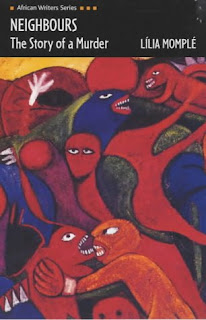
ASIDE: The cover illustration of this book (at least the version I have from Heinemann as shown on the left) is by Malangatana. I got to know this great artist on the day he died, January 5, 2011, through a fellow blogger Abena Serwaa. His paintings are so unique that the very moment I saw the cover of this book I knew it is hi work (though I had only known him and his works for about two days as of the time of reading).

When Mozambique gained its independence on June 25, 1975, the country sought to help freedom fighters in South Africa and Zimbabwe in their quest to shatter the chains of oppressive regimes: colonialism and apartheid respectively. However, the apartheid South African government of the time financed and sponsored armed groups in Mozambique called the Mozambique National Resistance (RENAMO) to sabotage the new government through murder and various acts of terrorism. This sabotage was aimed at destabilising the new government and inciting the citizens to reject the influx of South African refugees and ANC (African National Congress - South Africa's political organisation that was fighting against the apartheid government) members into the neighbouring country. 

It is within this setting that Momplé's story is told. She writes in the preface:
Oppression can take many forms. Neighbours was written out of my horror at the way countries can abuse each other's sovereignty for their own ends with impunity. Like many Mozambicans, I lived through decades when South Africa did as it pleased in Mozambique in order to protect the interests of the apartheid regime. During this period many Mozambicans were killed or had their lives destroyed. It is to them that I dedicate this book.
A sad premise for a story, even more when the premise is factual rather than fictitious. Neighbours is a story about the lives of five families - two of which would later become the victims and three, the perpetrators - as they struggle through the dark days leading to Mozambique's independence and the gloom and hopelessness that hung over the country such that people thought it best to flee the country and seek better living in various European countries especially Portugal.

Romu is a black Mozambican whose allegiance to the Portuguese' (the colonialist) cause is runs deep and is unquestionable. This resolve to protect the colonialist's grip on power results from an unstable childhood heaped onto him by his promiscuous mother and his own delinquencies. So that when the colonialists lost its grip on power and acceded to FRELIMO's (the organisation that fought for independence) campaign and fight for independence Romu's heart was broken. He felt his entire life's work - fighting alongside the colonialist's troops as they killed black Mozambicans - has come to naught. It is within this sombreness that he was approached by the two South African terrorists - Rui (a Mozambican who had fled to South Africa after the unsuccessful September 7 reactionary coup d’état by Portuguese settlers) and a real South African Boer. Romu sees the killing of Mozambican citizens to further the cause of white supremacy in South Africa, which would perhaps lead to the return of the Portuguese to Mozambique, as a chance to bring back the colonialist to power. Thus, Romu's motive of joining this massacre is his hatred against his own people.

Zaliua's motive of joining this cause was a thirst for revenge. Having left his mother in the hinterlands of Mozambique into the city, Zaliua worked his way up to become the head of the Criminal Investigation Police in Nacala under the colonial government. Thereafter Zaliua resorted to cheating, and corruption to enrich himself. However, a year after independence he was deposed, arrested and sentenced to a prison term. His wealth having been accumulated through corrupt practices were confiscated. However, Zaliua upon release decides to seek vengeance on the country and its people that have let him down; that never saw what he did to help them - appreciating his works with a prison term and poverty.

Dupont's motive was financially motivated. Coming from a family where every member is well-off, he is considered a loser and his marriage to Mena worsened his plight amongst his family, as Mena is considered to be of 'low social class' or 'an inferior race'. And when his family left for Portugal, Dupont made it a point to amass wealth in order to prove to his family that he could make it without their help.

These three individuals together with the two terrorists entered into the neighbourhood of Narguiss, an obese woman who - at the night of Eid, when no moon has appeared to warrant the celebration - was waiting for his cuckold husband and Leia and Januario and their daughter, Iris, of two years.

The story is told within twenty-four hours with the sections marked by specific times that certain events took place. The storyline of each person or family seems to run independent of the other until they come together at the peak when the murders were committed. By providing enough background information of each person or family, the event of their deaths was more felt than it would have otherwise been had we known nothing about them. For instance, we know that Januario's family were burnt in his village after he was helped by his mother to escape the abjectness of their lives in the bush where he had lived with his family. We also know that Narguiss has a family of daughters, with the youngest at the university seeking to come out as a medical practitioner. We also know that that evening Narguiss was only waiting for the moon to appear and her husband to come home so they could celebrate the Eid together, as they had been doing over the years. And for all these innocent, normal people to be caught up in a scheme they know nothing about because one country wants keep its grip on power is, to say the least, upsetting.

Though this book is only 131 pages (excluding the glossary), all characters are fully developed and we could sympathise them, hate them, love them, pity them. Momplé strips the story down to its essentials. This story is thus a historical fiction, where the characters could easily be identified with by numerous individuals. My only problem is that it was short.

This is a book I would recommend to everyone lover of African literature especially the Lusophonic part of Africa.
_____________________________
Brief Bio: Lilia Momplé was born in 1935 on the Island of Mozambique and obtained a BA in Social Work in Portugal. She was Secretary General of the Mozambique Writers' Association from 1995 to 2001 and President from 1997 to 1999. She has also represented her country at a number of international cultural assemblies, and has recently been appointed to the UNESCO Executive Council. Her publications include No One Killed Suhara (1988), The Eyes of the Green Cobra (1997) and the script for the award-winning Mozambican video drama Muhupitit Alima (1988). Her novel Neighbours was first published in Portuguese in 1995. Lilia Momple lives with her husband in Maputo, the capital of Mozambique. (Source)

ImageNations Rating: 5.0 out 6.0

Wednesday, January 05, 2011

55. Voices Made Night by Mia Couto

Title: Voices Made Night
Author: Mia Couto
Translator: David Brookshaw
Genre: Short Story Collection (Anthology)
Publishers: Heinemann (African Writers Series)
Pages: 115
Year of First Publication: 1986 (in Portuguese); 1990 (in English)
Country: Mozambique

My first encounter with Mia Couto was his story The Birds of God in Contemporary African Short Stories. Having not been disappointed by this contribution, which again is present in this collection, I set forth to read his first collection of short stories, Voices Made Night. This collection of fourteen short stories was the last book I read in 2010 and the first book I review 2011. It also marks the beginning of the Africa Reading Challenge.

From the magical realism of The Birds of God, to the political realities of The Barber's Most Famous Customer, The Whales of Quissico and The Tale of the two who Returned from the Dead, Mia Couto has put together an eclectic collection of stories that is bound to hold a reader's attention until the last word of the last line is read.

Though known for his magical realist stories, themes on struggle, poverty, emptiness and the inequalities that exist in relationships have all been covered in this collection. Broadly, the stories could be put into two categories: relationship, which in itself entails diverse types, and politics. However, behind each of these stories is a compelling narrative style that sucks the reader in.

The Fire, which opens this anthology, tells of a man eagerly digging his wife's grave. In this story, which happens to be my favourite, both husband and wife sees the other to be 'ill' or 'shrinking'; however, whereas the woman just thought about it, the man set out to prepare his wife's grave even though she had not shown any sign of sickness. The Day Mabata-bata Exploded, tells of a different kind of relationship - one between a boy and his uncle, who does not recognise him as a child, assigning him to look after his cattle rather than sending him to school. Then one day the fattest cow meant to be a dowry exploded. In How Ascolino De Perpetuo Socorro Lost His Spouse, the relationship between an alcoholic husband and an introvert wife is explored. So You Haven't Flown Yet, Carlota Gentina explores a long-held belief in most countries - witchcraft. What happens when a man's brother-by-marriage comes to tell him that his (the latter's) wife is a witch, that he has actually caught her in the act? The man convinced that
Witchcraft is a vice of sisters, an illness they are born with (Page 48)
set out to monitor his wife and catch her transfiguring into an animal. Waiting in vain, he mapped out a plan to facilitate the transfiguration process by pouring hot water on the wife. It was only when his wife died from the burns and the man was serving a prison sentence that his brother-by-marriage told him that what he saw was a mistake. In this story and others like it Mia Couto clearly shows his inclination to be the mouth piece of the 'weak: women and children'. He vividly portrays men as weak and minions:
The power of a minion is to make others feel even smaller, to tread on others just as he himself is trodden on by his superiors. (Page 47)
A man seeking a bright future for her daughter tied her to a drum in an attempt to train her as a contortionist. Later he was to learn that the information that contortionists earned more money was false. This is the story of The Girl with a Twisted Future. What happens when a woman decides to marry a man who is bent on becoming a priest? What if the girl, after several visits to the future priest, becomes pregnant? This is a tale that is better read than told and it is the story of The Ex-future Priest and His would-be Widow. In Patanhoca, the Lovesick Snake Catcher, a man described in all ugliness falls in love with a lady. To avoid competitors he surrounds her house with snakes. 

Behind all these stories is the political struggle among the white Portuguese, black Mozambicans and Mulattoes. The revolution leading to independence was also prominent in the stories. However, blatant reference to politics was made in The Barber's Most Famous Customer, where a famous local barber was arrested for harbouring a terrorist after he had bragged about shaving a white man's hair by showing a postcard picture of a white man. So that when he told the arresting officers that he was only joking and that it was merely a propaganda to get more customers, they replied:
'A joke, let's see about that. We know only too well there are subversives here from Tanzania, Zambia, wherever. Terrorists! It's probably one of those you put up here.' (Page 113)
And in The Whales of Quissico a disillusioned man set out to find a whale that vomits goods. Waiting for the whale's arrival, the man was visited by his friends who informed him that there was no such whale and that
'... back in Maputo it's being rumoured that [he's] a reactionary
after the authorities perceived his stay at the shore as way to smuggle arms into the country. The Tale of the Two Who Returned from the Dead is a story about corruption, bureaucracy and politics. In this story two friends returned to camp after the village was washed by flood only to find that their names have not been included in the 'not-dead' and so were officially considered dead. It took the intervention of a commission to investigate and establish that they are alive.
'We have closely examined the situation of the two individuals who arrived in the village, and have reached the following formal decision, namely that comrades Luis Fernando and Anibal Mucavel should be deemed members of the population in existence' [...] Next day, [they] began to see to the question of the documents that would prove they were alive. (Page 76)
In The Talking Raven's Last Warning, magic and deceit converge to produce a story that makes it difficult to believe and even harder not to believe. A man vomits a raven that could see into the netherworld and communicates with the dead, at least that is what the man says. Suddenly, people began trooping into the man's house to seek help from the necromantic raven.

Varied though the stories are, a sub-theme of dystopia threads through them all. In each of these stories we find the struggles of everyday life. One thing that makes this collection a fun to read is Couto's skill with words and images. With Couto every word, like the yarn of a weaver, is important, feeding into the overall meaning and strengthening the beauty and appreciation of each piece so that one cannot pull out a word without a domino effect. Writing with poetic ability, lines such as
'Now is it only the sun that rains?' (Page 58)
I am a blind man who sees many doors. (Page 48)
My throat had gone blind. (Page 45)
Happiness stepped out of her life and forgot to return. (Page 83)
The widow wrapped herself in a cloak of sourness, becoming ever more widowed. [...] She would finish when the beer had wetted all her blood. (Page 84)
His voice lay prostrated on the ground. (Page 111)
are bound to stay with the reader. His handling of metaphors, personifications, synaesthesias and many of such literary devices, is unique; this adeptness together with his precise use of language and of diction, makes Mia Couto a must read by all literary enthusiast.
__________________________________
The Fire
The Talking Raven's Last Warning
The Day Mabata-bata Exploded
The Birds of God
How Ascolino Do Perpetuo Soccoro Lost His Spouse
So You Haven't Flown Yet, Carlota Gentina?
Saide, The Bucket of Water
The Whales of Quissico
How Old Jossias Was Saved From The Waters
The Tale of The Two Who Returned From The Dead
The Girl With A Twisted Future
Patanhoca, The Lovesick Snake Catcher
The Ex-future Priest and His Would-be Widow
The Barber's Most Famous Customer

ImageNations Rating: 5.5 out of 6.0

Mia Couto
Author's Brief Bio: Antonio Emilio Leite Couto was born on July 5, 1955. At fourteen his poetry was published in the local newspapers. He intended to study medicine but had to suspend his studies to take on become a Journalist in 1974. Eleven years later, after running and head several institutions, Couto entered the university to finish his course in Biology. He has over twenty literary works published in more than 20 countries in several languages including Portuguese, English, French, German, Italian and Catalan. His first publication, in 1983, was a collection of poems titled Raiz do Orvalho. Voices Made Night, first published in 1986 in Portuguese, is his first collection of short stories. His recent publication, a novel, is titled Jesusalem (2009). Sleep Walking (Terra Sonambula, 1992) was considered as one of the top 12 African books of the 20th Century by the Zimbabwean International Book Fair. Having won many awards, such as the first African to win the prestigious Latin Union Literary Prize, Mia Couto now works as a biologist. And still writing.
Related Posts Plugin for WordPress, Blogger...

Featured post

Njoroge, Kihika, & Kamiti: Epochs of African Literature, A Reader's Perspective

Source Though Achebe's Things Fall Apart   (1958) is often cited and used as the beginning of the modern African novel written in E...