Posts

Showing posts with the label Author: Leo Tolstoy

253. Anna Karenina by Leo Tolstoy*

Image
"All happy families resemble one another, but each unhappy family is unhappy in its own way" are the famous opening words of the tragic love story Anna Karenina (FP: 1877; 813) by Leo Tolstoy. This is perhaps the most famous first line one would read. Anna Karenina is a novel of many dimensions with ebbs and troughs. Set in Russia around the time of the liberation of the serfs, the novel deals with society: the people, the laws and the government. The main story revolves around Anna Karenina, the eponymous character of the novel.  Anna Karenina had returned from Moscow, where she had been to solve a problem between her brother, Oblonsky, and her wife, Dolly [Darya], after the former had cheated on the latter with his children's English governess and the marriage seemed destined for disaster. Initially, one would have thought that the story revolves around the Oblonsky family. However, it quickly settles on the Karenins. In Moscow Anna had met the playboy Vronsky, w...

#Quotes: Quotes from Leo Tolstoy's Anna Karenina*

Image
All happy families resemble one another, but each unhappy family is unhappy in its own way. [1] Yet, as often happens between men who have chosen different pursuits, each, while in argument justifying the other's activity, despised it in the depth of his heart. [16] The aim of civilisation is to enable us to get enjoyment out of everything. [35] Oh, you moralist! But just consider, here are two women: one insists only on her rights, and her rights are your love, which you cannot give her; and the other sacrifices herself and demands nothing. What are you to do? How are you to act? It is a terrible tragedy. [41] You know that capitalism oppresses the workers. Our workmen the peasants bear the whole burden of labour, but are so placed that, work as they may, they cannot escape from their degrading condition. All the profits on their labour, by which they might better their condition, give themselves some leisure, and consequently gain some education, all this surplus...

233. War and Peace by Leo Tolstoy

Image
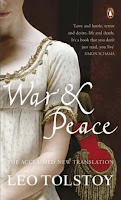
War and Peace by Leo Tolstoy (FP: 1869) translated by Anthongy Briggs (Penguin, 2005; 1392) is divided into four volumes and an epilogue and other extras. The reviews were carried out in the volumes and this is to consolidate for easy reference. Volume I:  This 313-page volume introduces the reader to the Bolkonskys - Prince Nikolay Bolkonsky, the father; Prince Andrey, the son married to little princess Liza, and Princess Marya, the daughter; the Rostovs - Natasha, the daughter; Nikolay, the son; Petya, the younger son, Vera, the eldest daughter; the Kuragins - the scheming Prince Vasily Kuragin who, unable to outwit Pierre (later Count Bezukhov of his inheritance), married his daughter, Helene, to him and was about to marry his son, the troublesome Anatole to Princess Marya because of Prince Nikolay Bolkonsky's riches but he failed. There was also the scheming Anna Mikhaylovna and his son Boris. ( continue here ) Volume II:  In this part, Prince Andrey Bo...

Volume IV: War and Peace by Leo Tolstoy

Image
Volume IV  (1035 - 1256) of  War and Peace  by Leo Tolstoy (FP: 1896) and translated by Anthony Briggs (Penguin, 2005; 1392) begins with a life in Petersburg after the abandonment of Moscow. It also shows how the Russians struggled to uplift themselves from the clutches of French culture and its recherche lifestyle. It should be noted that this is a period where the speaking of French is seen as the ultimate achievement of Russian gentry. However, this invasion blossomed in their hearts a sense of belonging and a sense of patriotism that traverse all aspects of life, including language. Life in Petersburg initially seemed to be unaffected and untouched by the invasion of Moscow; the aristocrats still held their parties, loose talks still flew around, and all thoughts of war and death were suppressed. However, as the news of Moscow's abandonment gradually filtered to the people, a general despondency overcame the people. In Moscow, Pierre who had been arr...

Volume III: War and Peace by Leo Tolstoy

Image
Volume III (665 - 1034) of War and Peace by Leo Tolstoy (Penguin, 2005 (1392); FP: 1869) translated by Anthony Briggs begins with a critical analyses of the human condition and human nature and man's place and role in world events and history and the misconception and false attributions that is fraught in our analyses of causes. Tolstoy's essay discusses predestination, man's role in humanity's history and the belief that man has control over historical events. Tolstoy agrees with (or Nassim Taleb rather agrees with Tolstoy) on man's epistemic arrogance regarding man's quest to understand events. He argued that man, with the benefit of hindsight, pretends to understand historical events when in fact he understands nothing and only isolates some actions as having caused such events because he can now, post-facto, look back and select any of the numerous causes and claim boldly that what he has identified is (or are) the real (true, actual) cause(s) of the even...

Volume II: War and Peace by Leo Tolstoy

Image
Volume II (315 - 664) of War and Peace by Leo Tolstoy (Penguin, 2005 (1392); FP: 1869) translated by Anthony Briggs concentrates less on the war with France and more with the shenanigans and trickery of the elite and those who pretend to be. There was also a lot marital unrest with, cheating, ranking highest. In this part, Prince Andrey Bolkonsky comes home the day his wife delivers and dies. This took the Prince into a period of gloom only to fall in love with Natasha Rostov and get his heart broken after she falls in love with the careless Anatole Kuragin. Pierre (Count Bezukhov) hears stories about his cheating wife, Helene, with his friend Dolokhov and challenges him to a duel of which both survives but Dolokhov left with a bullet wound. Pierre could be said to be the most frustrated person in the novel. He is seeking the meaning of life but finds that even for those who claim they have found the way, their lives is antithetical to what they preach and unable to reconcil...

Volume I: War and Peace by Leo Tolstoy

Image
I'm toddling my way through Tolstoy's tome, War and Peace (Penguin, 2005; FP: 1869; 1392). If I complete it, which I will, it'll be the longest book I've read. Because this book, and another, are perhaps going to be the only two books I'll read this month, I will have to update my reading progress to create blog content. Reading at a rate of at least 50 pages a day, it took me some five days (from March 2 to March 6) to complete Volume I of the four-volumed work (at a staggering 1392 pages and small font). This 313-page volume introduces the reader to the Bolkonskys - Prince Nikolay Bolkonsky, the father; Prince Andrey, the son married to little princess Liza, and Princess Marya, the daughter; the Rostovs - Natasha, the daughter; Nikolay, the son; Petya, the younger son, Vera, the eldest daughter; the Kuragins - the scheming Prince Vasily Kuragin who, unable to outwit Pierre (later Count Bezukhov of his inheritance), married his daughter, Helene, to him and w...