Posts

Showing posts with the label Non-African

302. The Master and Margarita by Mikhail Bulgakov

Image
The Master and Margarita by Mikhail Bulgakov, written over a twelve-year period (1928-1940) and published posthumously (1967), is a fantastic representation of phantasmagorical events that began with the portentous prediction whose realisation spelt doom for the entire inhabitants of Moscow, creating knots and entanglements that mere rationalisation was unable to coherently unwound or meaningfully disentangle.  The Great Deceiver, who in this case appeared as a great Magician, entered Moscow and, chancing upon a meeting of two literary enthusiasts at Patriarch's Ponds discussing the unending debate of the presence or otherwise of God, began a performance. The two self-professed atheists were strong in their conviction of a non-existent God and proffered argument after argument and hypothesis after hypothesis to support their thesis, until the arrival of Prof. Woland (the devil) and his retinue (Azazello, Behemoth the manlike-cat, Koroviev, Abadonna, and Hella,...

299-300: The Diamond As Big as the Ritz (by F. Scott Fitzgerald) & Daisy Miller by Henry James

Image
300. Daisy Miller by Henry James: My first impression after reading this novel was one of disappointment.  It seemed too simple. I waited for something to happen but it never did until the main character died. However, like Fitzgerald, the story shows the progress society has made. The story is about social restrictions placed on young ladies. In the novel, it was frowned upon for a young unmarried woman to be seen in the company of a young man she is not engaged with for such a length of time without the presence of an elder woman. The problem was that some of these restrictions differ and when Daisy arrived in Europe where such restrictions were tough, she was confused and ignorant of what she was to do. Thus, reading the novel one is likely to think that Daisy is a tough woman brazenly defying society, yet it turned out that she was totally ignorant of the laws and that she was only flouting them in innocence. Though not a good representation of Henry James, it still provides ...

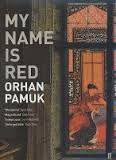
296. My Name is Red by Orhan Pamuk

Image
This belongs to the books I read when my interest in read was waning. I did not get to review it. And I am not going to do so now. Again, I am going to state what I remember of this book so we can discuss it, if you have read it.  One of the reasons I wanted to read Pamuk was that he is a Nobelist, having won it in 2006. Besides, he's Turkish and the Turkish have a rich history including the Ottoman Empire, making it a joy to read the level of sophistication of the time. This book covers a lot in just over 500 pages. I cannot seem to recollect and link the strands but this is what I remember: Each character narrates his part of the story in the first person in chapters dedicated to him or her. Thus there are multiple narrators in the story who are aware of each other. The narrators know each other and they know they are characters. The story begins with a murder with the would-be murder narrating his part of the story followed by a dog and a tree; The narrators are also awa...

295. Kafka on the Shore by Haruki Murakami

Image
Usually, when I read a book I make an attempt  at reviewing and sharing with my readers. Sometimes attempt fails. Sometimes it feels like smugness: why should anyone pay attention to you when there are a thousand splendid reviews on the same book. This feeling becomes worse when I am talking about a non-African book. Consequently, I am changing the tack today. Today, we are all going to review this beautiful, and yet unsettling, book together. Yes, you and I - we; that is, if you have read it. this Kafka on the Shore is a story of two strands: the story of the 15-year old Kafka Tamura around whose neck, or on whose head, lay a huge chunk of Oedipal curse; and an old Nakata who lost a large part of his mental faculties when he survived a long coma induced by strange lights somewhere in the forests during the World War II, when he was a child. Nakata, however, gained the ability to talk to cats and to make strange things happen, like making leeches fall from the sky. Kafk...

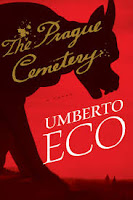
294. Prague Cemetery by Umberto Eco

Image
Abracadabra! And I appeared. As suddenly as I 'disapparated'. Blogging became boring. I got other interests. I learnt (still learning) a computer language, took up some courses related to my 'profession', Kofi - my son, came along etc. But I also (re)read a few books, about which I did not blog. Hence, I will be attempting to go back in time to just talk about (not review) some of the books I read.  Prague Cemetery falls into the kind of books that could hold your attention span for longer periods of time. Those books that are exactly as you perceived them to be. For those Dan Brown fans (of which I am not excluded), take any of Dan's books, add more intriguing plots, and crank up its literary value. To this, add the fact that almost every character in this novel has a historical counterpart, and you will get an amazing book that takes you through the historical development of conflicts, assassinations, and much more. The book sought to portray how individuals...

293. Birdsong by Sebastian Faulks

Image
The first Faulks' novel I read was Devil May Care , a story written to mark the centenary celebration of he creator of the James Bond character, Ian Fleming. Unfortunately, I did not enjoy the book. Perhaps, I would have liked the movie better. This is due to the different demands I place on movies and books. I expect more intellectual discourse from books, and more action (though I hate war movies) from movies. Consequently, this book stayed on my bookshelf for almost three and half years. I was scared of opening it, until I ran-out of books to read. This is one of those books you read and begin to wonder why you have not read it all this while, especially when it has been staring you in the face for years, begging you to pick it up and at least read the first line. According to the blurb ' ...Sebastian Faulks creates a work of fiction that is as tragic as A Farewell to Arms  and as sensuous as The English Patient .' And having read both books I should more than agr...

291. The Adventures of Sherlock Holmes by Sir Arthur Conan Doyle

Image
Sir Arthur Conan Doyle's famous book The Adventures of Sherlock Holmes  (FP: 1892; 302) is one of those books that manage to surprise you regardless of how familiar you have become with their titles. The surprise with this book was not in the character or the story-line(s) but the genre. I had always perceived this book as a complete novel. This perception might have been strengthened by the various movie adaptations I have watched. Even when I purchased it, this did not change. So you can imagine my surprise when I finally picked it up to read and suddenly discovered that it is a collection of short stories. The story features the eponymous character Sherlock Holmes as he solved one mystery after the other, sometimes aided by his friend Dr Watson, and it was he who narrated the stories. The eccentric Sherlock Holmes did not care much about the mysteries he solved but to any observing eyes what he did is nothing different from the art of Houdini. Sherlock has more than five ...

285-287 The Lord of the Rings (I - III) by J. R. R. Tolkien

Image
The Lord of the Rings , written between 1937 and 1949, was published in three volumes between 1954 and 1955. According to Tolkien it was not meant to be three separate books, however the size of the manuscript (original manuscript is estimated at 9,250 pages) dictated the form in which the publications would take. This is seen in the structure of each book, which many Harry Potter fans have used against it without realising that unlike the Potter series which was planned to be a seven-series book, the LOTR was not. Each Volume does not have a complete arch; it does not visibly rise and fall. This structure is however seen when all the three books are taken together. Though these books had been in circulation for over forty-six years, it was not until the movie production that the name of Frodo, Bilbo, Sauron, Gandalf, and Gollum became household names and Tolkien became a worldwide phenomenon. Today, only a handful of individuals could be absolutely ignorant about The Lord o...

283. The Satanic Verses by Salman Rushdie

Image
The Satanic Verses  (Viking, 1988; 547) by Salman Rushdie has been one of the most controversial books ever written. On February 14, 1989 a fatwa was declared on its author by the late Ayatollah Ruholla Khoneini. All across the world there were news of book burning and banning, and demonstrations against the author and his works, including some liberals who thought Rushdie overstretched the limits of free speech in his book. Even as the book celebrates its 26 years of publication and the author 25 years of the invocation of the fatwa, emotions have not yet completely fizzled out . In fact, the author had to live incognito and had to move about with bodyguards paid for by some governments. He lived under the assumed name of Joseph Anton - from Joseph Conrad and Anton Chekhov - which became the title of his memoir. The Story:  At over 500 pages, this is no small book and if one read the hardcover with the thick leaves one would feel the physical torment of this book. How...

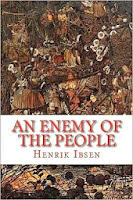
264. An Enemy of the People by Henrik Ibsen

Image
An Enemy of the People  (1882; translated by Farquharson Sharp) by Henrik Ibsen is a play that critically examines society's role in its political and ideological enslavement and the elements that prevent or impede its progress. The questions: whether 'the government of the people by the people for the people' is a concept that exists or is even possible; the 'rightness' of the majority, which is the basis of democracy; and the end result of unquestioned liberalism, are all answered in this stupendous play. It critiques society's choices, and the factors that influence those choices: are the choices leaders make made in the interest of the people or are they made in the interest of a few who, armed with the tools given them by the people, make the people believe the reverse? Or is society deceived to choose the very option that is counter to its interest, serving instead the interest of the privilege minority, as in this story? In this story, set in a Nor...