Posts

Showing posts with the label Country: Britain

293. Birdsong by Sebastian Faulks

Image
The first Faulks' novel I read was Devil May Care , a story written to mark the centenary celebration of he creator of the James Bond character, Ian Fleming. Unfortunately, I did not enjoy the book. Perhaps, I would have liked the movie better. This is due to the different demands I place on movies and books. I expect more intellectual discourse from books, and more action (though I hate war movies) from movies. Consequently, this book stayed on my bookshelf for almost three and half years. I was scared of opening it, until I ran-out of books to read. This is one of those books you read and begin to wonder why you have not read it all this while, especially when it has been staring you in the face for years, begging you to pick it up and at least read the first line. According to the blurb ' ...Sebastian Faulks creates a work of fiction that is as tragic as A Farewell to Arms  and as sensuous as The English Patient .' And having read both books I should more than agr...

291. The Adventures of Sherlock Holmes by Sir Arthur Conan Doyle

Image
Sir Arthur Conan Doyle's famous book The Adventures of Sherlock Holmes  (FP: 1892; 302) is one of those books that manage to surprise you regardless of how familiar you have become with their titles. The surprise with this book was not in the character or the story-line(s) but the genre. I had always perceived this book as a complete novel. This perception might have been strengthened by the various movie adaptations I have watched. Even when I purchased it, this did not change. So you can imagine my surprise when I finally picked it up to read and suddenly discovered that it is a collection of short stories. The story features the eponymous character Sherlock Holmes as he solved one mystery after the other, sometimes aided by his friend Dr Watson, and it was he who narrated the stories. The eccentric Sherlock Holmes did not care much about the mysteries he solved but to any observing eyes what he did is nothing different from the art of Houdini. Sherlock has more than five ...

285-287 The Lord of the Rings (I - III) by J. R. R. Tolkien

Image
The Lord of the Rings , written between 1937 and 1949, was published in three volumes between 1954 and 1955. According to Tolkien it was not meant to be three separate books, however the size of the manuscript (original manuscript is estimated at 9,250 pages) dictated the form in which the publications would take. This is seen in the structure of each book, which many Harry Potter fans have used against it without realising that unlike the Potter series which was planned to be a seven-series book, the LOTR was not. Each Volume does not have a complete arch; it does not visibly rise and fall. This structure is however seen when all the three books are taken together. Though these books had been in circulation for over forty-six years, it was not until the movie production that the name of Frodo, Bilbo, Sauron, Gandalf, and Gollum became household names and Tolkien became a worldwide phenomenon. Today, only a handful of individuals could be absolutely ignorant about The Lord o...

284. The Woman in White by Wilkie Collins

Image
The Woman in White  (FP: 1868; Penguin Popular Classic (1994), 569) by Wilkie Collins is the first book I read in 2014. It was a selection of the Book and Discussion Club of the Writers Project of Ghana for the month of February*. This is a fantastic story about love - found, lost, and found again; trust and mistrust; impersonation and title-chasing or more specifically an egregious quest for an upward movement into a more respectable class of English society; and about a misunderstanding that ended in divorce and loss (and regain) of reputation.  Laura Fairlie was engaged to marry Baron Percival Glyde; the match was made by Phillip Fairlie, Laura's father, before he died. Marriage between the two was therefore a matter of time, at least until a poor drawing master - Walter Hartright, around whom some of the events in the story surrounded, entered the Limmeridge household. The two - Laura and Hartright - were doomed to love each other the first day they met. Miss Maria...

282. Frankenstein by Mary Shelley

Image
Mary Shelley's Frankenstein (FP: 1818; Penguin Classics, 215) was the last book I read in 2013. The story is about one man's unbridled passion to acquire knowledge forsaking all other aspects of life, ending in his doom. Is it bad to forsake all else in the quest for knowledge? Is this not a fantastic quest for man to embark on? According to Mary, a false balance is an abomination to the Lord  [Proverbs 11:1a] and the unexamined life is not worth living for a human being  [Socrates]. Or that is what she implies in this Gothic creation of man's attempt at playing god gone wrong. In  Frankenstein , Mary describes the woes of a young Frankenstein who left home and his family and friends for school and there sought to investigate further and farther into the subjects of science and of creation to the exclusion of everything including his health. It was his single-idea to create a human being; yet, not being perfect, he could not perfect his creation and so produced a hor...

274. Animal Farm by George Orwell

Image
George Orwell 's Nineteen Eighty-Four and Animal Farm are classics in more ways other than literary. His exploration into the intricacies of politics, the psychology of politicians, and the eventual outcome of revolutions provides conclusions that are themselves revolutionary and almost incomparable. The former is the book that gave us words like Newspeak and Big Brother, whose frequency of use has shot up in this period of massive surveillance and draconian government agencies [1] . If the recent National Security Agency's (NSA) global surveillance has increased interests in Nineteen Eighty-Four , then the series of uprisings and pseudo-revolutions across Africa and the Middle East, christened Arab Springs by the Media, should equally force us to reread Animal Farm , as this book - more than any other - shows the effects of uncontrolled and unfocussed revolutions.  One can cite the Egyptian uprising which toppled the Mubarak regime and its successor Morsi government,...

267. Persuasion by Jane Austen

Image
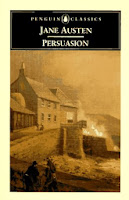
Writing about a Jane Austen novel, here on this blog, is like spitting into the Atlantic Ocean. There are Austen fans, Austen die-hards, Austen-scholars, Austen Societies, Austen-spawned novels and movies and anything one could imagine. However, what I take from Austen novels - I haven't read many - is that the society they lived in was not much different from other societies. In Persuasion (Penguin Classics, 1965 (FP: 1818); 264)*, as in the other two novels of hers I have read - Northanger Abbey and Pride and Prejudice - the theme is marriage and society's rules, obligations, and expectations surrounding that institution. Right from the beginning of this book, Austen - with her keen insight into life and the dynamics family life - exposed the biases and patriarchy of the society of the time; a society that ranked individuals of the two genders differently and further ranked people within each gender group according to their wealth, occupation, family status, name, ma...

242. Saturday by Ian McEwan

Image
Ian McEwan could best be described as a realist novelist, in addition to other descriptions that could best suit specific novels. For instance, Atonement is somewhat a metafiction where Briony was writing, partly, her story, in addition to being a historical novel. On Chesil Beach  is also, somewhat, a historical novel, which, through its characters, provides the pointers of change that has taken place. Saturday  (2005; 291 - Anchor Books) by Ian McEwan is the ultimate realist novel one might read and it is also one that would raise a lot of questions. The story is set on a specific date, February 13, 2003 - the day thousands (if not millions) marched against America's invasion of Iraq following the 9-11 terrorist attack. This attack means that terrorism has become a major topic for discussion including the Perowne household. The Perownes have a peaceful home. Their Blues guitarist son Theo, though has dropped out of school, was far from delinquent and very focuse...

215. Mrs. Dalloway by Virginia Woolf

Image
Virginia Woolf is an author I've heard of but have not read. Her books are on several Top 100 lists. When I chanced upon her book Mrs. Dalloway (Harcourt, 1925;197) I wasn't going to pass it by. Mrs. Dalloway  is a lifetime of events told over the period of a day through the point of view of Mrs. Dalloway as she goes about planning to hold a party for friends. The story was written in a very conversational manner, with repeated words and phrases for emphasis. The narrative takes place both within the minds of the characters and also outside of it so that we know what the other is think in addition to what is taking place externally. The third person limited narrative style combined with the omniscient voice was handled exquisitely so that transitions were very difficult to point out. Virginia Woolf zooms in on a character, describes him or her, talks about the person and then zooms out to include others and then before the reader is aware her lens is on another person. T...

214. Miss Pettigrew Lives for a Day by Winifred Watson

Image
I was inspired to read Persephone Books - which " reprints forgotten twentieth century novels,..., by (mostly) women writers " - by Marie of Boston Bibliophile . It was last year or so when she embarked on reading Persephone Books and I got interested but couldn't get the books. So when I came across this one, I snatched it quickly. Once a while you come across a book that leaves you asking for more, a book that is both funny and intellectually rewarding. There isn't many of such books; most intellectually rewarding books are simultaneously drab, insipid, and energy-sapping.  Miss Pettigrew Lives for a Day  (Persephone Books, 1938 (republished in 2000); 234) by Winifred Watson belongs to the former group of books. And it is also universal and timeless, like the works of the great Italian sculptors and painters. Miss Pettigrew is a governess on a job hunt, but she is a terrible governess and she knows it. When she is given the address of a young lady, suppos...

202. Amsterdam by Ian McEwan

Image
Ian McEwan is a minimalist. More of a novella-ist than an novelist. The Telegraph quoted him saying ' if I could write a perfect novella I would die happy '. In that same article he was described as 'lucky to be allowed to publish novellas.' If not for the lack of temerity one could say - in finality, in absoluteness - that he is the best novella-ist, for it isn't often that one comes across an author who pares down his words, weighs and analyses them before applying them, cutting out all unnecessary words just to arrive at the precise meaning of what he is carrying across. Such detailed work of cutting out, cleaning, paring, has often been associated with visual artists and poets. And now McEwan. Ewan's style is intense, absorbing, concentrated and focussed. His writings hardly entertain lateral stories, and even when they do they are an integral part of the main and contributes to the strength of the whole, like in Atonement . With his style and structu...