Posts

Showing posts with the label Nobel Laureate

A Quick Round Up of Literary Awards (#NLNGPrize, #ManBookerPrize, #NobelPrize)
Image
October has seen the announcement of several literature awards: from Nigeria's US$ 100,000 NLNG Prize, to the Pounds 50,000 Man Booker Prize. Overall, 2013 is the year for women writing, both young and old. NLNG Prize for Literature, Nigeria:  An Ibandan, Oyo State-based Lawyer and Poet, Tade Ipadeola, was announced the winner of the the 2013 Nigeria Prize for Literature. Ipadeola, president of PEN Nigeria, won the US$100,000 prize with poetry anthology The Sahara Testaments. The prize is sponsored by Nigeria LNG Limited.  The Sahara Testaments  won the prize ahead of Promise Ogochukwu's Wild Letters  and Chidi Amu's Through the Window of a Sandcastle.  The three entries were shortlisted from 201 entries received for the prize. The judges described  The Sahara Testaments as a remarkable epic covering the terrain and peopel of Africa from the very dawn of creation, through the present, to the future. The text uses Sahara as a metonym for the pro...

244. Auto da Fe by Elias Canetti

Image
Reading Elias Canetti's Auto da Fe (Penguin Modern Classics, 1935; 522)* after Fyodor Dostoevsky's Crime and Punishment  is like travelling on an underground railway connecting two cities in different countries - the transition is seamless and without notice. Not only were both books translations - one from Russian, the other from German - but they both address identical issues: introducing new elements into a hyper-functioning cognitive process leading to an imbalance that bothers on insanity. Again, both books discuss matters of knowledge or ideas, albeit in different forms; whereas Canetti discusses an intelligent bibliomania, Dostoevsky discusses a deductive theorist hoping to practicalise his theories. Finally, both books make references to ideas in other important books. It was therefore a unique privilege to have read these books in succession.* Professor Kien is a Sinologist, the best of his time. He has an extraordinarily boundless memory and can read several Ea...

#Quotes: Quotes from Elias Canetti's Auto da Fe

Image
Occasional collisions unexpectedly encountered determine the direction of a lifetime. [16] A bookseller is a king, and a king cannot be a bookseller. [16] The greatest danger which threatens a man of learning, is to lose himself in talk. [20] He reserved consciousness for real thoughts; they depend upon it; without consciousness, thoughts are unthinkable. Chewing and digesting happen of themselves. [32] The man who has frittered away the strength of his eyes is a worth companion of the beast that leads him. [35] Martyrs do not cry out, saints do not cry out. [45] [I]t is easy to be self-possessed when you have been dead for centuries. [51] Man alone was master of his fate. [64] Blindness is a weapon against time and space; our being is one vast blindness, save only for that little circle our mean intelligence - mean in its nature as in its scope - can illumine. The dominating principle of the universe is blindness. It makes possible juxtapositions whi...

218. A Farewell to Arms by Ernest Hemingway*

Image
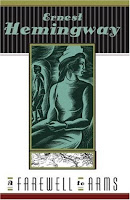
Ernest Hemingway's A Farewell to Arms (Scribner, 1929; 332) has been on several 'must-read' lists. Usually I'm not drawn to recently-published much-talked about books; however, when it comes to classics, it's different. This is one of those books that are easy, and yet difficult, to talk about. Easy in the sense that the story is not complicated and it is beautiful; difficult because Hemingway's prose defies description. The story is set in the midst of the World War I, on the Italian front. Lieutenant Henry, is an American ambulance driver working with the Italian forces. Henry meets Catherine Barkley, through a friend, and what blossomed from that meeting was innocent love. Though, Henry had gone into the relationship with a non-staying mentality, meeting the vernal and venerable Catherine exuding innocence and genuine affection, his ulterior motive extinguished in a flash. Slowly, he found himself fall deeper and deeper in love; a love so pure that onl...

212. Home by Toni Morrison

Image
There are some writers whose works conjure magic. Their control over words is ethereal; their use, quintessential, drawn from a deeper understanding and a personal relationship they have with them. These individuals become either linguists or storytellers; poets belong to such class of people. And Toni Morrison. Toni Morrison is an author whose oeuvre is worth a study . To describe the relationship between aficionados of Morrison's craft and Morrison, it would be important to paraphrase Sherman Alexie:   what you write we'll read.  In  Home  (Knopf, 2012; 147) Morrison continued her exploration of the lives of Black Americans during the time of segregation. Frank Money and his sister, his only sibling, Ycidra witnessed a burial, of a possible homicide. Now Frank Money has just returned from the Korean War with the horrors on his mind and the demons at his back. He is tormented by nightmares that sometimes cause him to behave insanely. In fact, it even led him ...

211. July's People by Nadine Gordimer

Image
It is apartheid South Africa. This time Blacks are up in arms, heavy arms, fighting the Whites. And the Russians and Cubans are here to help them. White South Africans are running for their dear lives. With nowhere to go, the Smales' family took the advice of their houseboy, a man they named July, following him to his family. July's People  (Penguin, 1981; 160) is about the changes in the roles and the dynamics of Black-White relationships. The Smales' are liberals whose relationship with South Africa Blacks in general and with their houseboy in particular is cordial and non-discriminatory. However, they were forced to analyse this view when it dawns on them that, though liberals as they are they could not speak any of the native's language whereas the apartheidists or their followers could and therefore found it difficult communicating with July's people. They never also did actually ask July of his real name. They just named him as such. How liberal is one ...

#NobelPrize: Mo Yan Wins the 2012 Nobel Prize in Literature

Image
At a few minutes to 11 am GMT, the Nobel Committee announced Chinese writer Mo Yan (57) as the winner of the 2012 Nobel Prize in Literature. The author whose works are often banned in his home country and are widely pirated is known for works such as Red Sorghum  and  Garlic Ballads.  His recent work Frog  was published last year and won the Mao Dun Literature Prize, 2011. Mo Yan - meaning 'don't speak' - is a pseudonym for Guan Moye; he becomes the first Asian since Kenzaburo Oe won it in 1994 - and if you count out his compatriot Gao Xianjing (2000) who is a citizen of France, he is the first non-European winner since 2003. Technically, Mo Yan is the first Chinese to have won the Nobel Prize in Literature. According to the Nobel Committee, The 2012 Nobel Prize in Literature was awarded to Mo Yan Who with hallucinatory realism merges folk tales, history and the contemporary. This award which, until now, had been given 108 times since 1901, and had su...

182. The Bluest Eye by Toni Morrison

Image
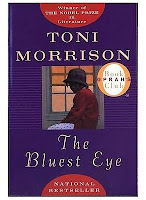
The Bluest Eye (Plume, 1970; 216) by Toni Morrison is one great of a read, just like all of the other Morrison's novels I've read. Like the others, this story deals with the socioeconomic and political dynamics of blacks, post-Emancipation. It also deals with identity, acceptance and placement through the lives of a given family, usually with an eccentric and idiosyncratic strong female character.  The Bluest Eye  which is Morrison's first novel deals with the identity and acceptance issues. It deals with a young girl who has been praying to God to make her eyes blue and when she thought she has got it, she wondered if she had the bluest eye in the world. However, the story is more than just an eleven-year old girl's quest for 'the bluest eye of all'; it also deals with the social dynamics: the role of men in the black family, the behaviour of the larger community and their effects on families. How Pecola - the young girl in question - was raped and impr...

151. Blindness by Jose Saramago

Image
Blindness  (Vintage Classics, 1997; 309; translated by Giovanni Pontiero) is a story that investigates human behaviour with political undertones; what makes someone do one thing and not the other; does the conscience behind an activity matter?  Jose Saramago, the 1998 Nobel Laureate, used this experimental book to investigate these issues in ways similar to William Golding's  Lord of the Flies . People are suddenly going blind in an unnamed city. A man in his car, waiting for the traffic light to turn from red to amber and then green, suddenly lost his sight. The Good Samaritan who took him home and later stole his car also lost his sight. The doctor who looked at his strange case lost his sight in his house whilst researching more on the man's conditions; a prostitute who had just left the doctor's place and was meeting her client got blind whilst having sex with this man. The authorities in order to contain, what became known as the white blindness - because...

142. Sula by Toni Morrison

Image
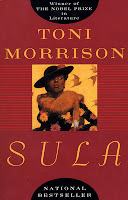
In Sula  (Plume, 1973; 174) Morrison continued her brilliant portrayal of the sad history of African Americans in a manner she alone could handle. Morrison's mind is different and the circumference of what is possible is wider than any other, except perhaps writers of science fiction and paranormal. And this is what makes Morrison a unique writer; for she sets her unique happenings in the midst of ordinary people and write of it (or them) as if it were normal everyday affair. In Song of Solomon  it was about Macon Milkman Dead following the 'wing-trails' of his ancestors who were deemed to have flown back to Africa to escape slavery (which is rooted in history). It was also about a Pilate, the woman who was born without a navel and who walked extremely great distances and did things that ordinary people cannot and would not be able to do. In Beloved it was about Sethe and her love for her children even after they escaped treachery and torture from Teacher. It is also abou...

140. Palace Walk by Naguib Mahfouz

Image
Title: Palace Walk Author: Naguib Mahfouz Translators: William Maynard Hutchins and Olive E. Kenny Original Language: Arabic Genre: Fiction/Socio-political Publishers: Anchor Books Pages: 498 Year of First Publication: 1956 Country: Egypt Al-Sayyid Ahmad Abd al-Jawad is the head of the al-Sayyid household on Palace Walk. Ahmad, as he is commonly referred to, is not a man like others. He believes in strict moral uprightness, unwavering respect and obedience and greatly abhors any attempt to challenge his position as the head of the household either from his sons, daughters, or wife. Consequently, he is strict, stern, firm and irascible. And even in a culture where nothing is held in highest esteem than self-preservation and morality of women, he is considered by his friends as extreme. But Ahmad is a man of dual personality: with his friends he is jovial and friendly. He laughs heartily and is known to be a great orator. And when he is with his concubine, the ...

130. Absalom, Absalom by William Faulkner

Image
Absalom, Absalom!*  (Vintage, 1936; 485) is a story of how a singular decision made by a poor boy, at a time when he was too young to understand anything, caused so much devastation to him and the people around him. The story follows from when that decision, and later others, was made and their effects through the generations, beginning from 1820 when the first malevolent seed was sown to 1910 when the last bitter fruit was harvested, or crushed. Thomas Sutpen appeared suddenly in Yoknapatawpha County. A strange man with strange looks, strange behaviour, strange language, and nigger followers. A man with an unknown past. A man who at fourteen made a decision, after he had been turned away from a big white house by a nigger who wears nice clothes, to create his own future wherein lies a big white house, niggers, and nobility. Sutpen was to acquire a hundred-square miles land from an Indian community through a process no one knew or could conjecture. Then he set ...