Posts

Showing posts with the label Country: United States of America

299-300: The Diamond As Big as the Ritz (by F. Scott Fitzgerald) & Daisy Miller by Henry James

Image
300. Daisy Miller by Henry James: My first impression after reading this novel was one of disappointment.  It seemed too simple. I waited for something to happen but it never did until the main character died. However, like Fitzgerald, the story shows the progress society has made. The story is about social restrictions placed on young ladies. In the novel, it was frowned upon for a young unmarried woman to be seen in the company of a young man she is not engaged with for such a length of time without the presence of an elder woman. The problem was that some of these restrictions differ and when Daisy arrived in Europe where such restrictions were tough, she was confused and ignorant of what she was to do. Thus, reading the novel one is likely to think that Daisy is a tough woman brazenly defying society, yet it turned out that she was totally ignorant of the laws and that she was only flouting them in innocence. Though not a good representation of Henry James, it still provides ...
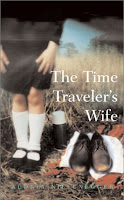
297. The Time Traveler's Wife by Audrey Niffenegger

Image
Audrey Niffenegger's The Time Traveler's Wife (2003) was one of the books I read last year or two. Again, I am not truly reviewing them. I am only talking about it. The story is about a woman who fell in love with a man with a genetic disorder that allows him to unpredictably travel through time. This unpredictability of his travels led to several problems in that relationship. However, through some means involving the future self of Henry, the man, Clare - the woman - got pregnant and gave birth to a daughter, Alba. Alba was also diagnosed with chrono-impairment, the genetic disorder that causes time travel; however, Alba was able to control her destinations and the times of her travels. The story seems to be about waiting for love and the problems that arise from such waiting. It is weird. This novel defies classification: is it a love story? Is it a science fiction? Have you read this novel? What's your opinion?

281. Dune by Frank Herbert

Image
Dune  (Berkley Books, 1965; 537) by Frank Herbert is a great science fiction that merges religion with science so that the point where one ends and the other begins is lost. Though it is a science fiction, and there is a complete creation of planets, its ecology, language and more, it is not too rigour so as to disturb those with no affinity for that genre. The extent of Herbert's creation is comparable to J.R.R. Tolkien's creation of the Hobbit's tales - in most of his books especially the three-part Lord of the Rings. The story shows the development of a leader with absolute control over the people. Since this is just the first book of the trilogy, the eventual end of the leader is not known. In Dune  the extent to which man will go to destroy nature just to serve his excessive luxury, even if it is at the expense of his fellow beings, was, if anything, emphasised. But it also shows the patience of man to build what he has destroyed, not at separate time periods; destr...

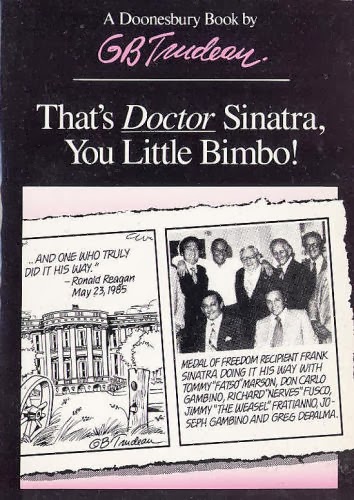
280. That's Doctor Sinatra, You Little Bimbo! by G. B. Trudeau

Image
G.B. Trudeau's That's Doctor Sinatra, You Little Bimbo! (Henry Holt and Company, 1985) is the second Graphic Novel I have read, or remember reading. Trudeau covers several issues with interlinking stories. The issues he broaches are those ironies that exist in democratic countries, in this case America. He covers almost every sphere of life: economics, politics, culture, social issues, and others. For instance, with illustrations, Trudeau punches or makes fun at the emergence of TV series, tanning, and the abortion-pro-life debate. In the latter, he satirises how the president's - perhaps Reagan's - role in a propagandist documentary that favoured the pro-lifers. In one of the skits he laughed at medical colleges at universities producing drugs under the guise of research and the FDAs banning drugs with potential psychiatric value. Trudeau also covers politics - both international and internal. Internally, issues such as racism and apartheid were discussed. Intern...

276. Delta of Venus by Anaïs Nin

Image
The main reason why I did not succumb to E. L. James's hyped trilogy was just because of that: the hype. I also did not believe that beyond the raunchy sex unleashed upon readers there could be anything worth to glean. My mind was made up right from the beginning: sex has become the god of capitalism. Everything would sell if you add a dose of it. Car shows are full of models, as if the people who buy those cars also buy the models in addition. Formula 1 is filled with models and boxing too. Music videos are the worst. Today, talent does not count; sex does. The more skin you show, the more shows you get to play. Susan Boyle was looked down upon because she did not meet the industry's standards. At least until she opened her voice. Yet, had she been svelte and shown more skin, much respect would have been shown her. So these are my bit about sex in the Twenty-first Century. However, when a reader is running out of books, even the most despised book gets the nod. I did not k...

261. The Parliament of Poets by Frederick Glaysher

Image
The Parliament of Poets  (2012) is a 294-page epic poem by Frederick Glaysher, which has the moon as its setting and deals with important issues such as science and religion, the current consumerist approach to our economics, profiteering and capitalism, gradual wearing away of morality and spirituality, wars, hunger, general deprivation, race, and more. It is a poem in twelve parts or Books. This review shall be restricted to Book I, which deals with the general issues covered in the individual books, and Book XI, which involves the persona's visit to Africa and involves Achebe's character in Arrow of God,  the Priest Ezeulu. As already stated the setting of this epic poem is the moon, specifically, the Apollo 11 landing site. The gathering of ancient and modern poets from both East and West was called by the Greek god Apollo and the Nine Muses. The main subject for discussion is the meaning of modernity and modern day nihilism. Several poets are gathered: Cervantes, D...

259. A Streetcar Named Desire by Tennessee Williams

Image
To begin with, this is a fantastic play. The themes it covers are as relevant today as they were at the time and a simple twitter search will support this: the play is still acted on stage and the people still love it. A Streetcar Named Desire  (1947) is about the effects of society's buckram moral dictates and norms on those who stand against them - individuals who, in living their lives and expressing themselves, go against these formalised regulations. It is easy to take today's liberties, and society's indifference to certain behaviours, for granted. It is easy to think that it has always been like that. The truth, however, is that the strong-hold of society - usually through religious dicta - on the actions of the individual means most of the freedom enjoyed today has at one time being fought for. Even today, the black American society has a dictum against their kinds who go about in their natural woolly hair. Ask Gabby Douglas , when she won Olympic gold in Gy...

258. The Adventures of Huckleberry Finn by Mark Twain

Image
When I began Mark Twain's The Adventures of Huckleberry Finn  (Washington Square Press, 1968 (FP: 1884); 374 p) what I expected to find within the age-browned pages was the adventures of a delinquent child; the farthest being that his youthful exuberance led him to do something positive, else he would not have written the book. I expected the trickery and stubbornness that afflict children at that stage of growth and development: an insatiable and inquisitive mind; an insane attraction to danger; an unquenchable love for exploration; and a restless spirit. What I did not expect to find in this seminal work is an in-depth analysis of race.  However, Mark Twain, in his prodigious mind, brought both the expected and unexpected in one hell of a book. To say that  Huckleberry Finn  is a seminal work on race is just as saying that a gold anklet is a trinket; it will be a gross understatement of this work. It is more than just seminal. Using the innocent, fun-lo...

240. On the Road by Jack Kerouac

Image
Art is usually marked by epochs. For literary writings such epochs include the Medieval, the Renaissance, the Enlightenment, the Romantic Period, the Transcendental Movement, the Victorian Period, the Realism, Naturalism, Existentialism, Modernism and others. Most of these eras are not distinct and there are overlaps. Sometimes one era would begin and end within a longer era. These timelines, though sometimes specific to countries, do have a universal application. Jack Kerouac's  On the Road  (1957; 291 - Penguin Books) is regarded as the flag-post of an epoch the author, it is cited, to have named. The Beat Generation, spanning a period of roughly two decades - from the end of the Second World War (1945) to 1965 - included such beautiful poets as Allen Ginsberg. This postwar period is marked by wanton search for happiness, freedom, self-discovery, and the meaning of life. The individuals in this period are like just-released cage birds. They fluttered across Ameri...

224. Speeches that Changed the World by Emma Beare (Editor)

Image
Speeches that Changed the World (Bounty Books, 2006; 192) edited by Emma Beare is a collection of speeches, interviews, dialogue and one-liners that are supposed to have marked an epoch in time. Sometimes these epochs are not long-lasting and the speeches not-world changing; sometimes the reverberations of the outcomes of the speeches can still be felt today, like John F. Kennedy's speech that empowered NASA and sparked the space race, which promised that America will put a man on the moon before the end of the 1960s and did. Today, Curiosity is on an exploratory tour on Mars. However, some of these speeches are there only for their beauty; this is the case in most of the one-liners - like the ones by Princess Diana - whose significant impact on world cannot be determined. Same can be said of Mark Anthony's speech delivered at the death of Caesar. The collection is mostly West-centric and not comprehensive enough. The only Africans in there are Nelson Mandela and F. W. d...

223. The Best of Simple by Langston Hughes

Image
The Best of Simple  (Noonday Press, 1961*; 245) by Langston Hughes is a collection of seventy very short stories serialised chronologically to tell the story of Jesse B. Semple (usually spelt Simple) - an average black Joe whose experiences and actions during the epoch of segregation could be described as representative of the larger black community, especially Harlem. From unstable jobs to living from day to day; from saving to marry to caring for a other family members; from the torments of segregation to becoming the head of a family, Simple's dialogue provides an insight to life and especially of dashed aspirations and frustrations of black Americans who had become slaves in the South and had to escape to the North to have some semblance of opportunities in terms of jobs as factory hands or maids, where the rights of black workers are not guaranteed. As expected, Simple talked about racial discrimination and how foreigners - as long as they are white - have more liberty ...

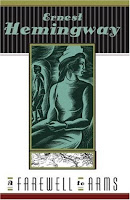
218. A Farewell to Arms by Ernest Hemingway*

Image
Ernest Hemingway's A Farewell to Arms (Scribner, 1929; 332) has been on several 'must-read' lists. Usually I'm not drawn to recently-published much-talked about books; however, when it comes to classics, it's different. This is one of those books that are easy, and yet difficult, to talk about. Easy in the sense that the story is not complicated and it is beautiful; difficult because Hemingway's prose defies description. The story is set in the midst of the World War I, on the Italian front. Lieutenant Henry, is an American ambulance driver working with the Italian forces. Henry meets Catherine Barkley, through a friend, and what blossomed from that meeting was innocent love. Though, Henry had gone into the relationship with a non-staying mentality, meeting the vernal and venerable Catherine exuding innocence and genuine affection, his ulterior motive extinguished in a flash. Slowly, he found himself fall deeper and deeper in love; a love so pure that onl...

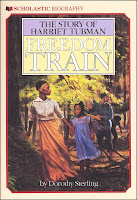
217. Freedom Train: The Story of Harriet Tubman by Dorothy Sterling

Image
I picked this book because I've read the name 'Harriet Tubman' in books and in poems where it represented the image of a bold and strong woman. However, for some reason, I've never taken the pain to explore further. Hence, when I saw a copy of  Freedom Train: The Story of Harriet Tubman  (Scholastic, 1954; 191) by Dorothy Sterling I never, for a microsecond, dithered in my decision to purchase it. This was the reason why I never discovered that the writing had been tailored toward younger readers; in Ghana possibly Junior High students. However, regardless of the unchallenging prose, a lot lies within the covers of the book. It tells the almost mythical story of Harriet Tubman with her slave-parents on a farm and how badly she was treated. One of such mistreatment crushed her skull and caused her to lapse into frequent sleeps. But even as a child, Harriet yearned for freedom and to do things her way. This story brings out the power of the will. Even when her brot...