Posts

Literary Analyses of M.anifest's Lyrics

Image
 I have not been posting for some time now. I've resorted to microblogging on Twitter and have found it difficult coming back here. However, I intend to return but with a twist. I would want to do a literary analyses of M.anifest's lyrics. M.anifest is a Ghanaian Hip-Hop artiste whose technical abilities and attention to the writing craft is unmatched. Unlike the usual, follow-the-crowd attitude, where technical dexterity is sacrificed for popularity and commercialisation, M.anifest has remained true to his craft, putting the art first. His latest album, MTTU (Madina to the Universe), is scheduled for release later in the year. I hope you enjoy this.

What are You Reading in these COVID times?

It's been a long long time. A lot has happened in my life and in the world at large. We have had this pandemic, which has locked almost every country down. In this period, there are few activities you can do and reading is one of them.  Share your COVID-19 Reading List with us so we can have an interesting chats. Tell us the favourite on the list and why.

The Commonwealth Short Story Prize Shortlist

Image
Twenty-four outstanding stories have been selected by an international judging panel from 5182 entries from 48 Commonwealth countries. The writers come from 14 countries including, for the first time, Samoa and Ghana. The Commonwealth Short Story Prize is awarded for the best piece of unpublished short fiction in English from the Commonwealth. As well as being open to entries translated into English from any language, it is the only literary prize in the world where entries can be submitted in Bengali, Chinese, Malay, Portuguese, Samoan, Swahili, and Tamil. Again, in 2018, we’re delighted that a translated story has reached the shortlist. The inclusion of other languages in the Prize speaks to Commonwealth Writers’ recognition of the need for linguistic diversity to promote the richness of varied literary traditions and lesser-heard narratives. The 24 entries have earned their place on the shortlist - a rich collection of stori es showcasing the skill and talent of the write...

Smiles from 35,000 ft

The lines blurred over teary eyes As yesterday's sentences crawled through the crenels of a hypnic-jerk mind Afraid to think of things the world taboos Yet bold to defend it resolutely in conversation with itself As I looked down from the roof of the earth I recreated your little cheeks swelling with laughter... the twilight twinkles in those tiny eyes... We may have endlessly, hopelessly fallen into this thing which has for years written itself into society's hypocritical epithet And we may have to ball it up and dump it in their dump-truck... Or timidly follow their path and forever hide this primal base from their accusatory eyes, away from: Them who hide their dangling scrotums in hideous togases to deceive naive maidens Them who walk the shore to rebuke the footprints of yesterday's memories Them who cast stones from behind books and creeds... But tell me, how does one bury a sailing cork? Why should one pluck a smile from 35,000ft and smash it agroun...

304. Afriku - Haiku & Senryu from Ghana by Adjei Agyei-Baah

Image
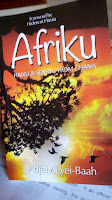
Art is dynamic. Art is adaptive. And regardless of where it originates, and with what rules, it is bound to transform and adapt to different cultures. The debate has always been to stick within the rules, be novel with the rules, or to break the rules entirely. But it is these debates, and how they are treated by active-passive artists and the critics alike, that makes art simply ART. It is what has kept it valuable and relevant in an age where the computer is determined to take over our lives and transform everything into a virtual non-reality. Haiku is just one poetry form. It is perhaps the shortest poetry form, albeit with the longest set of rules. One Haijin (a Haiku poet), Jane Reichhold wrote in her book that one must learn all the rules, practice them, and break them. This is such a difficult thing to do, breaking them. Nevertheless, it is what one must do to remain relevant or to adapt the art form to a given culture. And Haiku is one poetry form that requires a lot of ad...

Paul Beatty Wins the 2016 Man Booker Prize

Image
Paul Beatty's The Sellout  have been announced as the winner of the 2016 Man Booker Prize. This makes Paul the first American to have won the prize since the change in rules in 2015, allowing any book published in English in the UK eligible. According to the Man Booker Prize   "The Sellout is a searing satire on race relations in contemporary America", which was "described by The New York Times as a ‘metaphorical multicultural pot almost too hot to touch’, whilst the Wall Street Journal called it a ‘Swiftian satire of the highest order. Like someone shouting fire in a crowded theatre, Mr. Beatty has whispered “Racism” in a postracial world.’" Though the prize has over the years been bogged with controversy - readers keening about its dumbing down  (sacrificing literary merit on the altar of readability) and the bolder ones threatening to form another prize , The Man Booker Prize is still an authoritative source for good books, new novelists, and bold n...

303. Black Ass by A. Igoni Barrett

Image
"Furo Wariboko awoke this morning to find that dreams can lose their way and turn up on the wrong side of sleep." With this foreboding line Igoni Barrett ushers the reader into the complex and funny world of Furo Wariboko who woke up one morning to find himself transformed into a Caucasian with a black-patched bottom, green eyes and red hair. However, this furious instantaneous genetic mutation did not affect his speech and so Furo looks like a foreigner but speaks like a Nigerian. How will Furo, a young graduate born and bred in a low-income suburb of Lagos and attending his first interview on the first day of this startling transmogrification, navigate the dangerous curves and turns of this identity quagmire? How will he convince people of his Nigerian identiy, when his looks rejects his name and his documents reject his looks? How will he face his family and tell them that he is the Furo they knew the night before? How will they reconcile the two Furos into his new phys...

The Commonwealth Short Story Prize 2017 Now Open for Entries

Image
One of the flagship projects of Commonwealth Writers , the Commonwealth Short Story Prize is now open for entries, with an international judging panel comprising judges from each of the five Commonwealth regions: Zukiswa Wanner (Africa); Mahesh Rao (Asia); Jacqueline Baker (Canada and Europe), Jacob Ross (Caribbean) and Vilsoni Hereniko (Pacific). The chair of this year’s panel is the novelist Kamila Shamsie, who is the author of six novels, including Burnt Shadows , which has been translated into more than 20 languages and was shortlisted for the Orange Prize for Fiction, and A God in Every Stone which was shortlisted for the Bailey’s Women’s Prize for Fiction. “One of the pleasures of short stories is the potential for encountering both breadth and concentrated depth of writing over the space of just a few stories. In the case of the Commonwealth Short Story Prize, the geographic range of the entrants, as well as the prize's track record of attracting extraordinary wri...

Interview with Tendai Huchu, Author of The Maestro, The Magistrate & The Mathematician

Image
Tendai Huchu ( Source ) Today, I bring you an interview (a discussion) with Tendai Huchu. I interviewed him when his first book The Hairdresser of Harare came out. He has published his second book: The Maestro, The Magistrate, and The Mathematician. I caught up with him via Facebook and this is what ensued. Nana Fredua-Agyeman : So how did The Hairdresser of Harare   do? And how was it accepted in Zimbabwe noting the subject matter? Tendai Huchu : The Hairdresser isn't a book I think much about now. I have moved on as an artist. It was well received in Zim. First print run sold out. Good reviews. It was a popular read. Nana Fredua-Agyeman : OK. Great. I'm surprised you say you think not much about it. Is it that you are more concerned with your new work? Tendai Huchu : Yeah, I am doing newer and, hopefully, more interesting stuff. I have/am evolving. For me, the next project is always more exciting than the last. I imagine it is the same for all writers. ...

302. The Master and Margarita by Mikhail Bulgakov

Image
The Master and Margarita by Mikhail Bulgakov, written over a twelve-year period (1928-1940) and published posthumously (1967), is a fantastic representation of phantasmagorical events that began with the portentous prediction whose realisation spelt doom for the entire inhabitants of Moscow, creating knots and entanglements that mere rationalisation was unable to coherently unwound or meaningfully disentangle.  The Great Deceiver, who in this case appeared as a great Magician, entered Moscow and, chancing upon a meeting of two literary enthusiasts at Patriarch's Ponds discussing the unending debate of the presence or otherwise of God, began a performance. The two self-professed atheists were strong in their conviction of a non-existent God and proffered argument after argument and hypothesis after hypothesis to support their thesis, until the arrival of Prof. Woland (the devil) and his retinue (Azazello, Behemoth the manlike-cat, Koroviev, Abadonna, and Hella,...

New Books Acquired

Image
Books are life. Good books are heavenly. A stack of books? - indescribable. The following are the books I have purchased since I last talked about new books  I have acquired : The Maestro, The Magistrate & The Mathematician  by Tendai Huchu. I came to know Tendai when he published The Hairdresser of Harare .  I interviewed him then. And I have an interview with him on this new book, which I am yet to post here. I was therefore surprised to find that the book organization, of which I am a member, Writers Project of Ghana, has copies of his book for sale, courtesy Farafina.  The Maestro, The Magistrate & The Mathematician  was published in 2015. My interest in reading Tendai's second book is to really understand the path his writing will take. Blood Meridian by Cormac McCarthy. John Banville describes the book as "unlike anything I have read in recent years, an extraordinary, breathtaking achievement." It has been considered as a great American novel...

301. Every Day is for the Thief by Teju Cole

Image
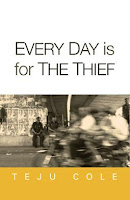
Every Day is for the Thief (2007; Cassava Republic) by Teju Cole is an interesting story that is difficult to categorise, if you are one in love with such mundane activities. In some aspects it is a novella - Teju says: " Every Day is for the Thief, written after I revisited Lagos after a long absence, is a novel "; however, in an attempt 'to capture a contemporary moment in the life of the city'...'much of the impetus comes from real-life events '. In this aspect, Every Day is for the Thief   is not just your everyday novel. It is more than that. The writing style, the plot (actually there was none), and the unnamed narrator writing about his travel makes it read like a travelogue, creative non-fiction style. However, at what point is a work of fiction, fiction? Or what proportion of fiction is required for a work to be described as such? Realist writers, whatever that term might mean, writes of the everyday happenings that the reader, if the book is set i...

299-300: The Diamond As Big as the Ritz (by F. Scott Fitzgerald) & Daisy Miller by Henry James

Image
300. Daisy Miller by Henry James: My first impression after reading this novel was one of disappointment.  It seemed too simple. I waited for something to happen but it never did until the main character died. However, like Fitzgerald, the story shows the progress society has made. The story is about social restrictions placed on young ladies. In the novel, it was frowned upon for a young unmarried woman to be seen in the company of a young man she is not engaged with for such a length of time without the presence of an elder woman. The problem was that some of these restrictions differ and when Daisy arrived in Europe where such restrictions were tough, she was confused and ignorant of what she was to do. Thus, reading the novel one is likely to think that Daisy is a tough woman brazenly defying society, yet it turned out that she was totally ignorant of the laws and that she was only flouting them in innocence. Though not a good representation of Henry James, it still provides ...

A Five-Year Reading Challenge that Ended Almost Two Years Ago

In October of 2009 , about seven months into my book blogging life, I came up with a plan to guide me read some fantastic books. I had just transitioned from reading 'everything' (or preferably pulp fiction) to literary fiction with focus on African literature. Realising how much I was missing, I set myself the target of reading 100 amazing books in five years. These books were to be exclusive of all other books I will read in the year. Thus, I can read other books but at the end of the five years I should have read these 100 books. I developed the list with vigour, with information from several sources (recommendations from friends and best books lists). This is the kind of challenge I cherish though I don't always complete challenges . However one challenging factor when it comes to challenges is book accessibility and it is because of this that I set the five-year target thinking that within that period the hurdle would have flattened out.  So I made a list of books...

The 2016 Man Booker Dozen - Should we Worry?

Image
The Man Booker Prize has, overtime, become the most prestigious literary award, not because of its 50,000 Pounds Sterling prize money (which is good but dwarfed by Nigeria's US$ 100,000 NLNG Prize for Literature), but for the fame and opportunities it opens up for nominees. To be long-listed is itself an achievement and the route to literary fame. Every year readers, writers, publishers and literary aficionados look forward to long-list and then the countdown to the shortlist and winner begins. Not until 2013, when it was announced that the award will be expanded (in 2014) to cover all books written in English by any author anywhere on the planet but published in the UK, the Man Booker has been reserved for only authors in Britain, Ireland, the Commonwealth, and Zimbabwe. Since its inception in 1968, the prize has given out 48 awards (including the Lost Man Booker Prize in 1970 and the award-sharing in 1974); however, very few nominees and, therefore, fewer winners have come f...