Posts

303. Black Ass by A. Igoni Barrett

Image
"Furo Wariboko awoke this morning to find that dreams can lose their way and turn up on the wrong side of sleep." With this foreboding line Igoni Barrett ushers the reader into the complex and funny world of Furo Wariboko who woke up one morning to find himself transformed into a Caucasian with a black-patched bottom, green eyes and red hair. However, this furious instantaneous genetic mutation did not affect his speech and so Furo looks like a foreigner but speaks like a Nigerian. How will Furo, a young graduate born and bred in a low-income suburb of Lagos and attending his first interview on the first day of this startling transmogrification, navigate the dangerous curves and turns of this identity quagmire? How will he convince people of his Nigerian identiy, when his looks rejects his name and his documents reject his looks? How will he face his family and tell them that he is the Furo they knew the night before? How will they reconcile the two Furos into his new phys...

The Commonwealth Short Story Prize 2017 Now Open for Entries

Image
One of the flagship projects of Commonwealth Writers , the Commonwealth Short Story Prize is now open for entries, with an international judging panel comprising judges from each of the five Commonwealth regions: Zukiswa Wanner (Africa); Mahesh Rao (Asia); Jacqueline Baker (Canada and Europe), Jacob Ross (Caribbean) and Vilsoni Hereniko (Pacific). The chair of this year’s panel is the novelist Kamila Shamsie, who is the author of six novels, including Burnt Shadows , which has been translated into more than 20 languages and was shortlisted for the Orange Prize for Fiction, and A God in Every Stone which was shortlisted for the Bailey’s Women’s Prize for Fiction. “One of the pleasures of short stories is the potential for encountering both breadth and concentrated depth of writing over the space of just a few stories. In the case of the Commonwealth Short Story Prize, the geographic range of the entrants, as well as the prize's track record of attracting extraordinary wri...

Interview with Tendai Huchu, Author of The Maestro, The Magistrate & The Mathematician

Image
Tendai Huchu ( Source ) Today, I bring you an interview (a discussion) with Tendai Huchu. I interviewed him when his first book The Hairdresser of Harare came out. He has published his second book: The Maestro, The Magistrate, and The Mathematician. I caught up with him via Facebook and this is what ensued. Nana Fredua-Agyeman : So how did The Hairdresser of Harare   do? And how was it accepted in Zimbabwe noting the subject matter? Tendai Huchu : The Hairdresser isn't a book I think much about now. I have moved on as an artist. It was well received in Zim. First print run sold out. Good reviews. It was a popular read. Nana Fredua-Agyeman : OK. Great. I'm surprised you say you think not much about it. Is it that you are more concerned with your new work? Tendai Huchu : Yeah, I am doing newer and, hopefully, more interesting stuff. I have/am evolving. For me, the next project is always more exciting than the last. I imagine it is the same for all writers. ...

302. The Master and Margarita by Mikhail Bulgakov

Image
The Master and Margarita by Mikhail Bulgakov, written over a twelve-year period (1928-1940) and published posthumously (1967), is a fantastic representation of phantasmagorical events that began with the portentous prediction whose realisation spelt doom for the entire inhabitants of Moscow, creating knots and entanglements that mere rationalisation was unable to coherently unwound or meaningfully disentangle.  The Great Deceiver, who in this case appeared as a great Magician, entered Moscow and, chancing upon a meeting of two literary enthusiasts at Patriarch's Ponds discussing the unending debate of the presence or otherwise of God, began a performance. The two self-professed atheists were strong in their conviction of a non-existent God and proffered argument after argument and hypothesis after hypothesis to support their thesis, until the arrival of Prof. Woland (the devil) and his retinue (Azazello, Behemoth the manlike-cat, Koroviev, Abadonna, and Hella,...

New Books Acquired

Image
Books are life. Good books are heavenly. A stack of books? - indescribable. The following are the books I have purchased since I last talked about new books  I have acquired : The Maestro, The Magistrate & The Mathematician  by Tendai Huchu. I came to know Tendai when he published The Hairdresser of Harare .  I interviewed him then. And I have an interview with him on this new book, which I am yet to post here. I was therefore surprised to find that the book organization, of which I am a member, Writers Project of Ghana, has copies of his book for sale, courtesy Farafina.  The Maestro, The Magistrate & The Mathematician  was published in 2015. My interest in reading Tendai's second book is to really understand the path his writing will take. Blood Meridian by Cormac McCarthy. John Banville describes the book as "unlike anything I have read in recent years, an extraordinary, breathtaking achievement." It has been considered as a great American novel...

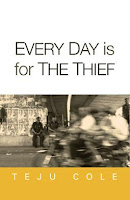
301. Every Day is for the Thief by Teju Cole

Image
Every Day is for the Thief (2007; Cassava Republic) by Teju Cole is an interesting story that is difficult to categorise, if you are one in love with such mundane activities. In some aspects it is a novella - Teju says: " Every Day is for the Thief, written after I revisited Lagos after a long absence, is a novel "; however, in an attempt 'to capture a contemporary moment in the life of the city'...'much of the impetus comes from real-life events '. In this aspect, Every Day is for the Thief   is not just your everyday novel. It is more than that. The writing style, the plot (actually there was none), and the unnamed narrator writing about his travel makes it read like a travelogue, creative non-fiction style. However, at what point is a work of fiction, fiction? Or what proportion of fiction is required for a work to be described as such? Realist writers, whatever that term might mean, writes of the everyday happenings that the reader, if the book is set i...

299-300: The Diamond As Big as the Ritz (by F. Scott Fitzgerald) & Daisy Miller by Henry James

Image
300. Daisy Miller by Henry James: My first impression after reading this novel was one of disappointment.  It seemed too simple. I waited for something to happen but it never did until the main character died. However, like Fitzgerald, the story shows the progress society has made. The story is about social restrictions placed on young ladies. In the novel, it was frowned upon for a young unmarried woman to be seen in the company of a young man she is not engaged with for such a length of time without the presence of an elder woman. The problem was that some of these restrictions differ and when Daisy arrived in Europe where such restrictions were tough, she was confused and ignorant of what she was to do. Thus, reading the novel one is likely to think that Daisy is a tough woman brazenly defying society, yet it turned out that she was totally ignorant of the laws and that she was only flouting them in innocence. Though not a good representation of Henry James, it still provides ...