Posts

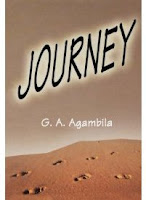
198. Journey by G. A. Agambila
Image
Journey (Sub-Saharan Publishers, 2006; 304) by G.A. Agambila is a novel about life and the uncertainties and mystery surrounding it. It is also about swimming against the cold currents of penury and traditions whilst showing the developmental gap between the Northern and Southern part of the country, Ghana. This developmental gap is no fiction and the story of the North-South migration is a common one for most folks. The motif of the story could easily have been autobiographical as most students who completed their secondary education had to either come down south (to the University of Ghana located at Accra or University of Cape Coast located at Cape Coast) or stop over at Kumasi (at the Kwame Nkrumah University of Science and Technology), in the middle part of the country, if they wanted to further their education to the university level. It still is the case even though the northern sector now has a university. There is also, in this story, of teenage trysts and frivolity. ...
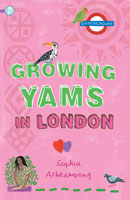
197. Growing Yams in London by Sophia Acheampong

Image
The proportion of Ghanaian writers, both at home and in the diaspora, are incomparable to countries like Nigeria, whose authors have become household names, names we throw about in every literary discussion, names like Achebe, Soyinka, Okri, Chimamanda, Elechi Amadi, Buchi Emecheta and others. If there are few Ghanaians involved in the art of weaving words into novels, there are fewer - in fact, they could be counted on the fingers of one hand - whose writings are directed towards the youth or who dabble in the type of books commonly referred to as Young Adults. And I can count only one name: Nana Brew-Hammond whose Powder Necklace  was reviewed here. Today, another check-box has been ticked and a new name added. Sophia Acheampong's Growing Yams in London (Piccadilly Press, 2006; 220) is a Young Adult fiction about first and second generation Ghanaians in England working tirelessly to find a compromise between between the culture of their homeland and that of their adoptive ...

Picture Speaks: Chinua Achebe, Two Years after His Debut

Image
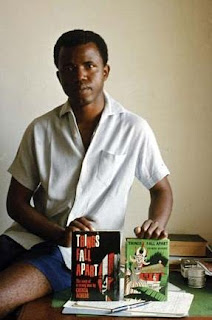
Chinua Achebe in 1960 A reader is likely to have the image of a favourite author fixed in his or her head forever. Usually, this image will be a representation of the author at the age or period the reader got to know him. Hardly will it change. Thus, if the author became a favourite in his old age, this image sticks and rarely does one look back on the author's younger years. And vice versa. I chanced upon Chinua Achebe 's picture, supposedly taken two years after the publication of his debut novel Things Fall Apart . I must say that I've never ever thought of searching for this author in his youthful days. When  Things Fall Apart was published, in 1958, the author was twenty-eight. Have you seen your favourite authors in their young days (if they are old)? And can you identify them? This picture was obtained through Seun Writes and I hope I'm using it fairly since I'm not benefitting - financially - from its use here.

196. Women Leading Africa: Conversations with Inspirational African Women, Edited by Nana Darkoa Sekyiamah

Image
Issues of women, the world over, are peculiar for its similarities than its differences. The issues confronting women are not specific to any given culture, continent, country or even ethnic grouping. They are colour blind, nonracial, and ageless. They are ubiquitous. Even in the so-called developed countries where the fight for gender equality has been fought and achievements chalked to such an extent that it (gender equality) has become commonplace, one could easily point to certain discrimination against the fair sex; nevertheless, the intensity - depth and width - of this discrimination varies across cultures. Because these problems emanate from an established patriarchal society, they are structural in nature and, when not interrogated and challenged, are bound to be propagated from one generation to the other, even by individuals who have no intention of maltreating women or discriminating against them; for no one is explicitly tutored to hate women. They are only asked to imp...

#ManBookerPrize: Hilary Mantel Wins the 2012 Man Booker Prize

Image
Hilary Mantel has won the 2012 Man Booker Prize with her book Bringing Up the Bodies, a sequel to her 2009 Booker-Prize-winning novel Wolf Hall .  The 50,000 Pounds prize was announced on October 16, 2012 at 9:40 pm British time at a dinner at Guildhall. This win makes her the third author to have won the Booker Prize on two different occasions. The other two are Peter Carey (1988 & 2001) and J.M. Coetzee (1983 & 1999).  She is the first person to have the first two books of a trilogy win the Booker Prize. Could she make it three in three?  Read more here . The Guardian reported that the Chair of Judges, Peter Stothard, described Hilary Mantel as 'the greatest modern English prose writer.'

195. The Corrections by Jonathan Franzen

Image
The Corrections by Jonathan Franzen (Farrar, Straus and Giroux, 2001; 568) is a disquisition on American pop culture and the American family as it transits from a period of familial bond and quaint prohibitions to that of material bond and quick-fixes in a freer do-what-you-want world and where its [the family’s] values have shifted from a personal relationship among kin to a personal relationship with wealth, respectively. In this unforgiving but dispassionate analysis of the middle class, Franzen single-mindedly sought to expose the effects of wanton and desperate quest for wealth as expressed in uncontrolled consumerism, materialism, profiteering and above all the satisfaction of the singular self on the unifying role of the family as an institution and, therefore, on the American system. He exposes the darker side of a system that has put premium on consumption of commodities and that has redefined success as one’s ability to consume limitlessly. So much has consumption, of g...

#NobelPrize: Mo Yan Wins the 2012 Nobel Prize in Literature

Image
At a few minutes to 11 am GMT, the Nobel Committee announced Chinese writer Mo Yan (57) as the winner of the 2012 Nobel Prize in Literature. The author whose works are often banned in his home country and are widely pirated is known for works such as Red Sorghum  and  Garlic Ballads.  His recent work Frog  was published last year and won the Mao Dun Literature Prize, 2011. Mo Yan - meaning 'don't speak' - is a pseudonym for Guan Moye; he becomes the first Asian since Kenzaburo Oe won it in 1994 - and if you count out his compatriot Gao Xianjing (2000) who is a citizen of France, he is the first non-European winner since 2003. Technically, Mo Yan is the first Chinese to have won the Nobel Prize in Literature. According to the Nobel Committee, The 2012 Nobel Prize in Literature was awarded to Mo Yan Who with hallucinatory realism merges folk tales, history and the contemporary. This award which, until now, had been given 108 times since 1901, and had su...