Posts

Showing posts matching the search for ngugi

270. Dreams in a Time of War by Ngugi wa Thiong'o

Image
Stories of the atrocities and ills committed during colonialism most often seem fictional to people's ears, especially those who never lived within the period and never directly experienced them. To those twice removed from the action, it sounds like a fantastic tale told to children around the firelight, beneath the full moon. This might have occurred because for the larger part of the twentieth century, this has been the motif for several African writers - poets, novelists, dramatists. However, nothing is as real as the wanton devastation of the people by the colonists and colonialists in their bid to own the land and subjugate, or in their own way civilise, the people. It is through the biographies and memoirs of those who lived the times that the true effects of what was meted out to our fathers and grandfathers come alive. It is easy for one to disregard fiction, but not too easy to ignore a memoir.  And in the childhood memoir of Ngugi wa Thiong'o, one of Africa...

228. Wizard of the Crow by Ngugi wa Thiong'o

Image
Few authors are able to keep their theme running for such a long time as Ngugi has done. As a critic of the post-independence politics of the new wave of African leaders, Ngugi wa Thiong'o knows more about the tricks, chicanery, and shenanigans of these people than most people. He has observed and written about it both in fiction and in essays. His keen interest has always been the lack of socialisation of government efforts and the endemic corruption that has strangulated several African countries, including his home country of Kenya - which had to go through a series of Constitutional reforms after the 2008 electoral crisis - from developing. Ngugi's observations, from the the dawn of independence when the capsule of euphoria burst and evaporated all at once leaving behind a blanket of realities, are encapsulated in his works. From his first novel Weep Not Child  (1964), which studied the hostile relationship between the colonialists and the colonised to Wizard of the Cro...

The Nobel and Ngugi's Cause - A Short Response to Tricia Adaobi's Article, 'In Africa, the Laureate's Curse'

Image
Ngugi wa Thiong'o Discussions have been going-on , ever since Tricia Adoabi's article In Africa, the Laureate's Curse , was published in The New York Times . I had vehemently opposed to most of the issues raised in the article and had a facebook post of it yesterday. However, I really didn't want to blog about my qualms. Yet, to distance my comments from my blog would be a dereliction of duty, most especially when my blog exists mainly to promote African Literature. To begin with Adaobi Tricia Nwaubani is the author of that beautifully-written, award-winning novel  I Do Not Come to you by Chance , a novel that has been on my contemporary reading list but for its unavailability in Ghanaian shops I would have reviewed it on my blog. Now to the crux of the issue. Adaobi stated that: A Nigerian publisher told me that of the manuscripts she reads from aspiring writers, half echo Chinua Achebe and half try to adopt Wole Soyinka's style. (paragraph two) and then I kno...

Author's Country

Image
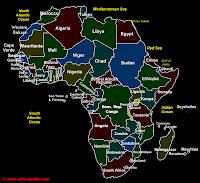
For other categories,  see Review I have sought to read from as many parts of Africa as possible. This index categorises authors by country. The categorisation is such that authors are listed according to the nationality they possessed when their works became famous. Thus, Bessie head is considered a Motswana from Botswana rather than a South African and Coetzee, a South African rather than an Australian. Non-African authors are listed under 'Other Countries'. Always, the author's last name comes first.  Anthologies:  If it is a single-authored anthology, the author's name appears under the country where the author comes from. For multiple-authored anthologies only the editor('s') name(s) are (are) used. If the anthology is multiple-editored and the editors come from the same country, only the name of the editor which comes first at the back of the book is used (example Ivor Hartmann and Emmanuel Sigauke both come from Zimbabwe, only the former is ...